

What Is an Atelier, and What Does It Change in Men's Clothing?
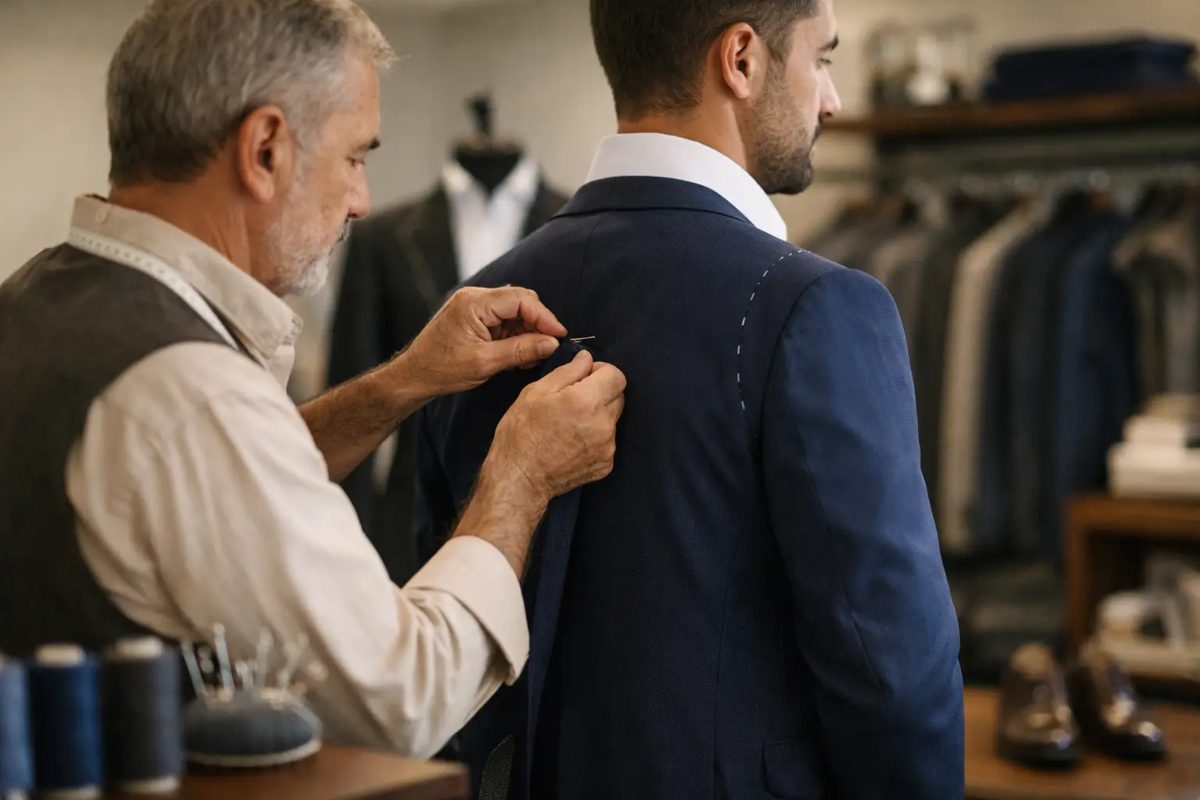
When the shoulders of a ready-made suit do not sit properly, the jacket's expensive cloth and well-known label fade into the background. In men's clothing, the real difference begins with a cut that understands the natural line of the body. The atelier is precisely the place where that difference is made: here a garment is not chosen from a rail but built around a man's measurements, his posture, the rhythm of his day and his taste.
In a business setting, at an official reception or at a ceremony of personal significance, a suit is more than clothing. It expresses a man's regard for himself, the value he places on detail and his quiet self-assurance. For this, the right measurements alone are not enough. The behaviour of the cloth, the construction of the jacket, the shape of the lapel and even the position of the cuff buttons must work together.
What is an atelier?
An atelier is the workplace of the culture of bespoke tailoring. Here the process does not end with reducing the client's build to a set of numbers. The tailor takes into account the slope of the shoulders, the line of the back, the carriage of the neck, the natural position of the arms and the habits of movement. The aim is not to produce a suit that conforms to a size chart, but a suit that looks natural on its owner.
This approach is fundamentally different from ready-to-wear. A ready-made suit is produced to certain standard body proportions, with limited alterations made afterwards. In an atelier, the cut is built from the outset on individual characteristics. As a result, the shoulder line of the jacket looks cleaner, the collar sits close to the neck, the waist takes shape without constricting, and the trousers keep their comfort in movement.
It must also be acknowledged that in bespoke tailoring not every commission produces the same result. The experience of the master, the attention given to the measuring stage, the cloth chosen and the quality of the fitting process are decisive. The concept of an atelier does not mean simply made to order; it means professional observation and responsibility.
The difference between an atelier and made-to-measure
These two terms are often used to mean the same thing, but there is an important distinction between them. Made-to-measure is usually the adaptation of an existing pattern to the client's measurements and choices. The client selects the cloth, buttons, lapel style and a number of other details, and the pattern is altered within certain parameters. Compared with ready-to-wear, this gives a more personal and often more precise result.
Bespoke is a deeper process. Here the pattern is created directly for the client and carries not only his physical characteristics but his aesthetic requirements as well. The structure of the shoulder, the opening of the chest, the length of the jacket, the width of the lapel and the balance of the skirt are all considered in relation to one particular man's silhouette.
Which choice is more appropriate depends on need. For a client with limited time who has already found a pattern that suits him, high-level made-to-measure can be the practical option. For a man whose build differs more noticeably from the standard, or who wants a fully personal result from his very first suit, bespoke is the more thorough approach. In both cases the goal is the same: harmony between the garment and its owner.
Choosing the cloth is about more than appearance
At first glance, suiting cloth is judged by colour and pattern. Yet the choice of cloth determines how the suit breathes, how it moves on the body, how prone it is to creasing and how it will hold its shape over the years. A light, open-weave wool can be more comfortable in Baku's hot season. A more densely woven cloth is suited to cooler weather, frequent travel and a formal working schedule.
The advantage of mills such as Loro Piana, Dormeuil, Piacenza 1733, Drago, Scabal, Reda and Zegna lies not only in their names. In their collections, the selection of fibre, the twist of the yarn, the density of the weave and the finishing methods create consistent quality. A very fine wool, for example, can look exceptionally elegant in the weave, yet it is not always the most suitable choice for heavy use. For an everyday business suit, the match between cloth and way of life is worth more than a glamorous label.
The tailor's consultation plays a particular role at this stage. Knowing how much of the client's day is spent in the office, in the car or travelling is the question to be asked before any choice of colour. Navy and charcoal grey form the stable foundation of the working wardrobe. But even within these colours, the weave, a subtle pattern and the degree of sheen change the character of the suit.
The balance between construction and comfort
The inner structure of a jacket is its invisible architecture. A full canvas construction has the potential to mould itself over time to its owner's shape through body heat and movement. A half canvas construction can offer a good balance of price, quality and comfort. A fused construction, though a quicker and more accessible solution, may not behave the same way under long-term use and in high temperatures.
There is no single correct answer here. For formal occasions, a classic wardrobe and many years of use, a more structured jacket is appropriate. A model with softer shoulders and lighter construction can feel more natural for an active working routine and informal meetings. The essential point is that the jacket should remain comfortable not just when first put on, but several hours later too.
Why is measuring in an atelier so detailed?
Taking measurements is not merely a matter of passing a tape around the chest and waist. An experienced tailor observes how the client carries his body while standing. One shoulder may be lower than the other, the back may lean slightly forward, the movement of the dominant arm may require extra ease in the jacket sleeve. These characteristics are not flaws; they are the individuality of the human body.
The fitting stage exists to test those observations. If, at that point, the collar of the jacket stands away from the neck, if excess cloth gathers at the waist, or if the break of the trouser does not fall correctly over the shoe, a correction is made. This is where the value of a commissioned garment becomes clear: measurement is not information gathered once, but a dialogue used to refine the result.
For Atelier Baku 1984, this process stands at the centre of the personal meeting. The goal is not to repeat the fashion of the season, but to find the proportion that the client can wear with confidence for years to come.
The great effect of small details
What first draws the eye in a suit is usually the overall silhouette; what stays in the memory is the details. The width of the lapel should relate to the structure of the face. An excessively narrow lapel can quickly look dated on a classic suit intended for many years of wear. The number of buttons, the shape of the pockets, the height of the side vents and the choice of lining also determine the environment in which the suit will live.
In the shirt, the neck size and the shape of the cuff should be considered together with the tie, the watch and the sleeve length of the jacket. A seven-fold tie made of Como silk, because it takes its shape with less internal padding, shows the volume of the knot and the flow of the silk differently. Such a tie, especially combined with a well-cut shirt and the right collar, adds unobtrusive depth to the appearance.
When choosing bespoke clothing, it is enough to come to the first consultation with clear answers about your daily life: where will you wear the suit, in which season will you use it most, and what would you like to change in your appearance? Precise questions lead to the right cloth, the right construction and, in the end, a garment that looks inseparable from you.