

What Are the Marks of Quality in an Expensive Suit?
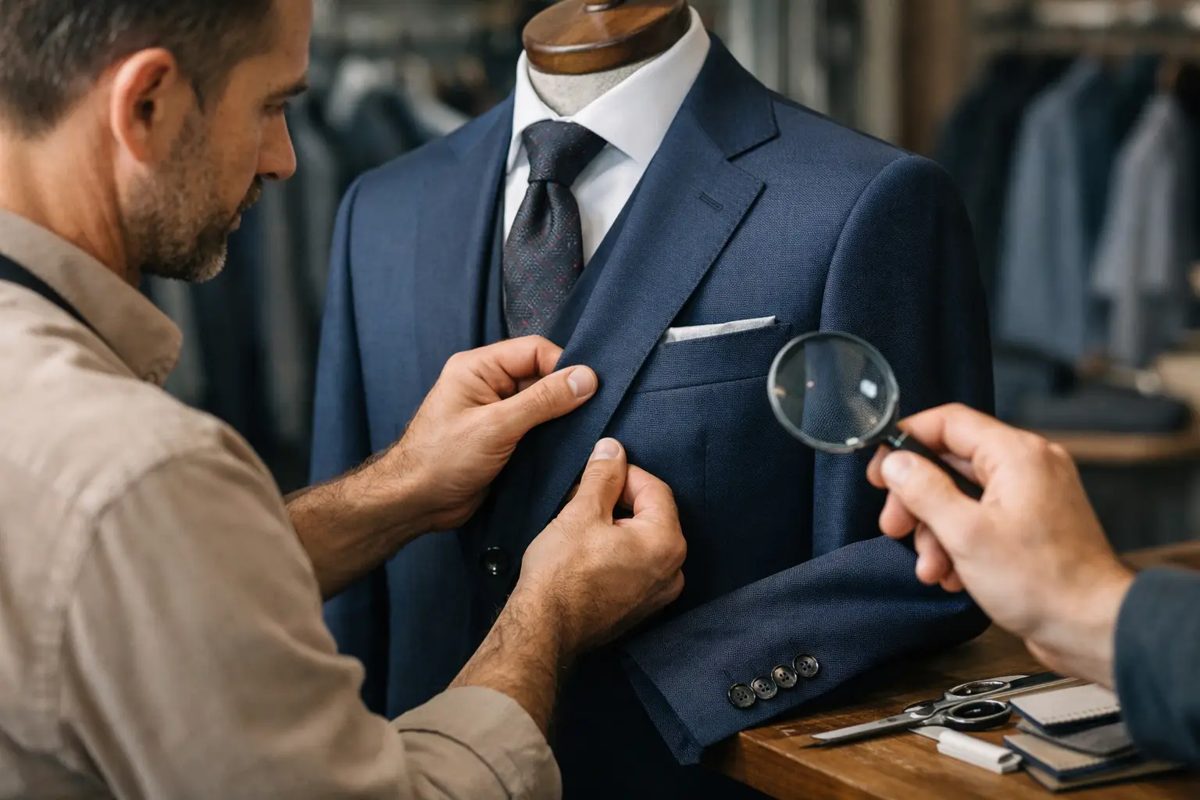
To judge the level of a suit without seeing its price tag, it is enough to touch the cloth, press the lapel lightly and look at the shoulder line. The marks of quality in an expensive suit lie not in a logo that catches the eye at first glance, but in the comfort felt as you move and in a silhouette that looks calm and natural on the body. Real quality does not display itself — it carries itself.
At business meetings, official receptions and important private occasions in particular, a suit expresses not only a man's taste but his attitude to detail. For this reason an expensive suit is not merely a choice of fine cloth. It is the union of the material's origin, the inner construction, the precision of the cut and the handwork of the tailor.
The marks of quality in an expensive suit begin with the cloth
A high-grade suiting cloth should be soft to the touch, yet not excessively thin or fragile. The density of the cloth, the twist of the yarn and the purity of the fibre determine both its appearance and its lifespan. The advantage of mills such as Loro Piana, Dormeuil, Piacenza 1733, Scabal, Drago, Reda and Zegna lies not only in their names but in their selection of raw material and their weaving discipline.
Yet a higher Super number does not always mean a better choice. A Super 150s or 180s wool, for example, can look very fine, delicate and formal, but for intensive daily wear a good Super 110s or 130s wool is more appropriate. The finer the fibre, the more gently the cloth behaves and the more careful attention it demands. For a man with a demanding schedule, durability is sometimes worth more than maximum fineness.
Good cloth does not give off an artificial sheen under the light. Its surface looks alive, deep and clean. In navy, charcoal grey or brown tones this depth is especially noticeable: the colour is not flat, and as the cloth moves it creates subtle variations of tone. Polyester blends often look smooth and attractive at first, but over time they can develop shine, static and shapelessness.
Season and purpose are inseparable from the cloth
When choosing a suit for the Baku climate, one should look not merely at the name of the mill but at the weight and weave of the cloth. In the cooler months, flannel, twill or a somewhat more densely woven wool feels more substantial and comfortable. In the hot season, a high-twist wool, a wool-silk blend or an open-weave cloth can be superior in terms of breathability.
The right choice here depends on the personal scenario of use. For an executive who travels a great deal, a more crease-resistant cloth is practical. In a suit intended only for evening occasions, the lustre of silk or the flow of a finer wool may be appropriate. The expensive choice is not buying the most expensive cloth — it is matching the cloth correctly to one's way of life.
Inner construction is the invisible value of a suit
However the jacket of a suit stands on the body, its inner structure is working in the same way. In a fully fused construction, the front is shaped by means of heat and adhesive. This method is convenient for rapid production, but over time it can lead to bubbling in the chest, stiffness and an unnatural drape.
In a quality suit, by contrast, the shape of the chest and lapel is built with canvas — natural interlayers of horsehair, wool and cotton. This layer adapts to body heat and movement, allowing the jacket, as time passes, to settle more naturally into its owner's silhouette. Full canvas construction is considered the highest level, but half canvas, when properly executed, is also a very sensible and high-quality choice for an everyday suit.
The way the lapel lies flat against the chest is one of the clearest indicators of this construction. If there is a gap between the collar and the shirt, or bunching at the back of the neck, even the most beautiful cloth will not give the desired effect. The front of the jacket should not pull when buttoned, and should not look loose and lifeless when left open.
The shoulder line and the armhole
The shoulder is the hardest part of a suit to correct. The shoulder seam should stop at the point where the natural shoulder ends, neither drooping outwards nor rising upwards. A heavily padded shoulder may be a deliberate choice in certain formal silhouettes, but it is not a universal sign of quality. The essential point is that the shoulder should look calm and in proportion to the body.
A high, correctly cut armhole is another important feature of expensive tailoring. It prevents the whole body of the jacket from riding up when the arm is raised. A wide armhole seems comfortable at first, but in movement it spoils the shape of the suit. Comfort is achieved not by creating excess in the cloth, but through correct construction.
The cut should suit the body, not the fashion
A problem often encountered with ready-made suits is this: even when the chest and shoulders fit, the waist, sleeve length or the fit of the trousers demands a compromise. The value of the made-to-measure and bespoke approaches emerges precisely at this point. A measurement is not merely a chest circumference; posture, the slope of the shoulders, the line of the waist, the natural position of the arm and even the difference between one shoulder and the other must be taken into account.
When a well-fitting jacket is buttoned, no X-shaped tension appears across the chest. There are no horizontal creases at the back, and the side vents do not pull open. The shirt cuff shows roughly one centimetre beyond the jacket sleeve, and the length of the jacket balances the proportions of the body. These rules are not immutable law, but behind them stand the classic proportions that show the silhouette most precisely.
Trousers demand the same attention. The waist should sit comfortably without a belt, no excess cloth should gather at the seat, and the hem should neither crease excessively over the shoe nor give the impression of being too short. A modern, slim cut is not the right choice for every build. Elegance comes not from constricting the body, but from knowing how to give it room.
What do the stitching and the handwork say?
In an expensive suit the stitching is straight, dense and consistent, but the aim is not to demonstrate that every stitch was made by hand. Machine stitching can provide great precision and durability. Handwork, on the other hand, creates value particularly in the collar, the lapel, the setting of the sleeve into the jacket, the buttonholes and the delicate shaping elements.
Look closely at the edge of the lapel. The light, living line produced by hand stitching gives the jacket a depth that is not rigid. Whether the sleeve is joined to the shoulder with a gentle gathering — spalla camicia — or with a more classically expressed sleeve head depends on the tailor's aesthetic intention. What matters here is not that each detail should be highly visible, but that it should serve the jacket as a whole.
Buttons, too, are a small but telling element. Horn, mother-of-pearl, corozo or high-quality bone buttons differ from plastic in both feel and appearance. The buttonholes should be cleanly cut, no threads should hang loose, and the buttons on the jacket sleeve in particular should be judged not as a decorative solution but as an indicator of the overall level of workmanship.
Lining, pattern matching and the level of finishing
The inside of an expensive suit is worked with as much care as its outside. A lining that does not cling to the body, cleanly sewn inner pockets and neatly bound edges are important for long-term use. A fully lined jacket can look more structured; a half-lined or unlined model feels lighter in hot weather. Which is better depends on the purpose of the suit.
In a striped or checked cloth, the matching of the pattern as far as possible at the side seams, on the lapel and at the pockets is a clear sign of craftsmanship. It requires more cloth and a more precise cut. The same rule applies to the shirt: orderly workmanship at the collar, the cuffs and the front placket completes the overall appearance alongside the suit.
Flawless finishing is sometimes invisible at first glance. But it reveals itself when the jacket is turned inside out, when a pocket is used, or when one sits and stands repeatedly over the course of a long day. The real test of quality is not a few minutes in front of the mirror, but wear repeated over years.
Price and value are not the same thing
A high price can be a signal of quality, but on its own it is not proof. The brand name, marketing, limited production and the place of sale also affect the price. What determines value is how many seasons the suit holds its shape, in how many different settings it looks dependable, and how natural it feels to its owner.
Seen in this light, a few well-chosen suits make a more rational wardrobe than numerous but compromised alternatives. A navy wool suit, a well-cut grey suit and an evening model suited to one's personal style can serve for many years when chosen with the right cloth and construction. Given rotation in wear, proper hangers and regular steaming, the cloth rests better.
At a bespoke tailoring house such as Atelier Baku 1984, the purpose of the consultation is not merely to take measurements. The aim is to understand the environment in which the suit will be worn, how its owner moves and which visual language he has chosen. The most valuable outcome in tailoring is that the suit should not enter the room before you, but should quietly complete the impression of authority when you speak.