

Why Does Bespoke Tailoring in Baku Make the Difference?
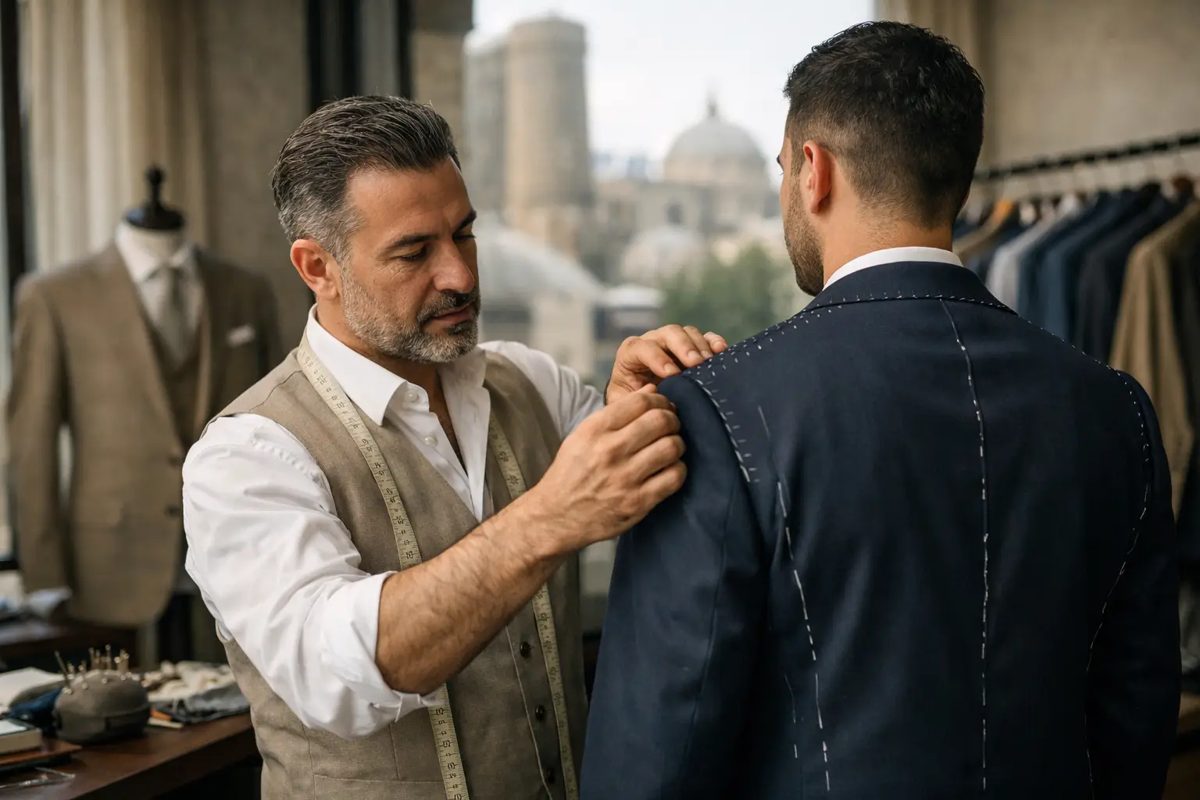
A ready-made suit may look right across the shoulders, yet pull at the chest when its wearer sits down, its trousers may lose their shape over the day, or the waist of the jacket may fail to express its owner's silhouette. Bespoke tailoring in Baku is chosen precisely to remove these small but decisive mismatches. The aim here is not simply to buy clothing in the right size, but to create a wardrobe built around a man's movement, his professional environment and his personal taste.
A good suit does not show itself off at first glance. The shoulder line sits calmly, the collar stays close to the neck, the chest does not hinder movement, and the length of the jacket completes the proportions of the body. This restrained precision is felt particularly at executive meetings, official receptions, wedding ceremonies or negotiations at an international level. The clothing does not divert attention from its owner; it shows his standing more clearly.
In bespoke tailoring, the difference begins with the cut
The idea of bespoke is often associated only with luxurious cloth. Cloth is of course fundamental, but the real difference begins in the construction. The tailor takes into account the symmetry of the body, the slope of the shoulders, the ratio of chest to waist, the posture and the natural movement of the arm. On the basis of these observations, an individual pattern is drafted for the client.
Ready-to-wear is built on average measurements. In the made-to-measure model, an existing base pattern is adapted to the client's measurements. For many men this can be a high-level and practical solution. In bespoke tailoring, the starting point is an individual pattern, which in turn makes it possible to respond to the finer characteristics of the body's structure.
This difference may not matter equally to every client. For a man of standard proportions who will wear the suit infrequently, a quality made-to-measure commission may be sufficient. But for a man who wears a suit as part of his daily working wardrobe, whose shoulder-to-waist ratio differs from the standard, or who wants to build a wardrobe for the long term, the bespoke approach makes more sense.
What to look for when choosing bespoke tailoring in Baku
A bespoke consultation does not begin with the cloth book. First, it must be established for what rhythm of life the suit is intended. How many days a week will it be worn; is its principal setting the office, travel or ceremonies; does the client prefer a more formal silhouette or a softer, more relaxed one? Without the right questions, even an expensive cloth can produce the wrong result.
Taking measurements is not merely numbers
Chest, waist, sleeve and inside leg are only the beginning. The tailor needs to see how the client stands and moves. In some men one shoulder sits slightly lower than the other; in others a forward-leaning posture or a more powerful thigh affects the construction of the trousers. When these details are overlooked, a suit may look good when first put on but become uncomfortable a few hours later.
This is exactly where the value of a personal meeting lies. The client is not merely measured; his expectations of the garment are read. Choices such as the buttoning point of the jacket, the width of the lapel, the shape of the pockets, the high rise of the trousers and the break of the hem are the continuation of that dialogue. Not every fashionable detail suits every build or every professional environment.
The character of the cloth matters as much as its name
The value of mills such as Loro Piana, Dormeuil, Piacenza 1733, Drago, Scabal, Reda and Zegna lies not only in their being recognised names. Their collections take into account the origin of the fibre, the fineness of the yarn, the density of the weave, the depth of the colour and the behaviour of the cloth. Two navy wool cloths may look alike on paper, yet one is drier and more formal, while the other has a softer, more fluid and more luminous surface.
The Baku climate also changes the choice. In the hot months, a breathable wool, a wool-silk or an open-weave cloth can be more comfortable. In the cold season, flannel, a fuller worsted wool or cashmere blends give the jacket depth. That said, a very fine and light cloth is not always ideal for intensive daily wear. It looks elegant, but it may crease quickly and demand more careful upkeep.
For a business wardrobe, a medium-weight wool with natural resilience that holds its shape is very often the most balanced choice. For a special evening event, a cloth with a silk blend or a more lustrous texture may be more fitting. Cloth should be judged not only in front of the mirror but in the light, in the hand and in movement.
Construction is the invisible quality
Some of the most important parts of a suit are not visible at first glance. The inner structure of the jacket, the canvas layers, the shape of the chest, the choice of lining and the balance of the seams determine how the garment will live on the body. Quality construction preserves the shape of the jacket without giving it the effect of a rigid shell.
Here too, the choice depends on personal need. A more formal, structured jacket can create a strong silhouette and is appropriate for official meetings. An Italian-style jacket of softer construction looks at ease when travelling, at lunch meetings and in the everyday city wardrobe. Both approaches are correct; the essential point is that they be chosen to suit their owner's way of life.
It is also a mistake to treat the trousers as a secondary detail. The correct rise, a comfortable seat, sufficient ease of movement through the thigh and a hem length that suits the shoe preserve the overall balance of the suit. However well the jacket is made, if the proportions of the trousers are wrong the result will look incomplete.
The shirt and the tie are the continuation of the suit
A bespoke shirt is not a simple base hidden beneath the suit. The shape of the collar should be chosen to suit the structure of the face, the knot of the tie and the lapel of the jacket. The size of the cuff, the shoulder line, the length of the sleeve and the ease across the chest are details felt throughout the day. For men who wear a tie in particular, the correct structure of the collar is important: an excessively soft collar loses its shape, while an excessively stiff one does not look natural.
A seven-fold tie made of Como silk goes beyond the notion of an accessory. In its construction the silk is folded several times over to take its shape, which gives the knot volume and life. Worn with a good shirt collar and a lapel of the right proportions, such a tie becomes a quiet yet distinguished finishing touch.
The choice of colour should be measured here as well. Navy, charcoal and mid-grey suits form the foundation of the wardrobe. Alongside them, white, light blue and finely striped shirts, together with textured ties in deep red, green or blue, offer wide scope for combination. On a first commission, favouring cloths that will work in different settings rather than a very ambitious pattern is usually the more far-sighted decision.
A bespoke commission requires time and attention
Bespoke tailoring is not a form of rapid shopping. Taking measurements, choosing the cloth and details, intermediate checks and final adjustments are a natural part of the process. This expenditure of time may seem a limitation, but in the end it provides the opportunity to test how the garment behaves in real use.
Rather than renewing the entire wardrobe on the first commission, it is a more considered approach to begin with one principal suit, two or three bespoke shirts and a tie suited to how often it will be worn. On subsequent commissions, the knowledge the tailor has gained of the client's cut and preferences makes the process more precise. In an atelier built around personal meetings, such as Atelier Baku 1984, this continuity serves to shape a personal wardrobe through logical choices rather than chance purchases.
A well-made suit does not try to speak in place of its owner. Through its correct fit, its chosen cloth and its quiet language of detail, it shows with greater confidence what the man already wishes to say.