

How to wear business casual in Baku
A working day in Baku rarely keeps one register. The morning meeting may be formal, while the afternoon conversation continues in a café rather than across a boardroom table. On days like that a full suit is often too much, and knitwear alone is not enough.
Business casual is the answer to exactly that gap. It is also the most misread dress code of all: most men take it to mean "a suit without a tie", and the result looks neither formal nor relaxed — merely unfinished.
The difference lies not in details but in logic. Business casual is built from separate garments chosen for one another; a suit is a single set, and it loses its logic the moment it is broken up.
What business casual does not mean
The first mistake is to take the suit jacket away from its trousers and wear it alone. Suit cloth is woven smooth and fine because it has to work as a whole set. Left on its own, that smoothness makes the jacket look thin: the weave says nothing to the eye.
The second mistake is to overcorrect. A jacket finished with denim and trainers is not dress for a business meeting; it is weekend dress, and it reads that way in a meeting room.
The third mistake is to replace formality with accessories. When the tie comes off and a bright pocket square or a large watch takes its place, the look does not grow calmer — it grows louder.
The jacket and the trousers are chosen apart
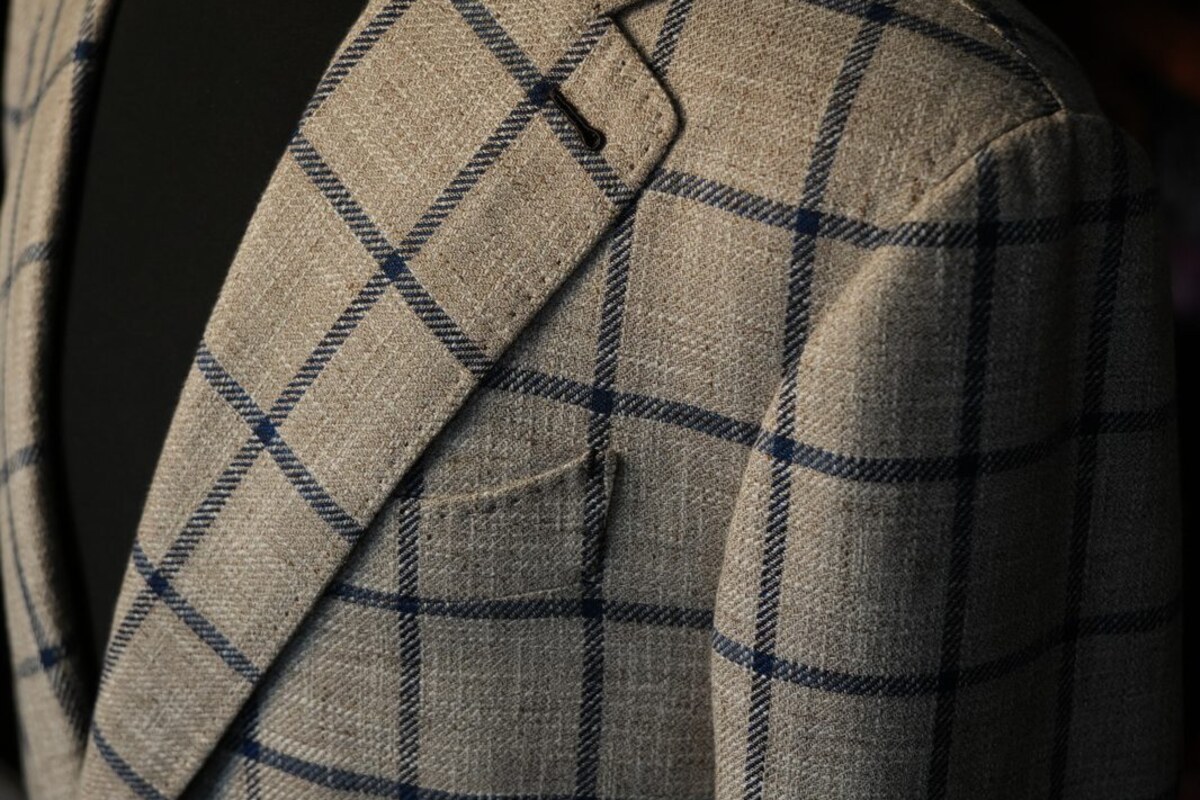
This is the heart of business casual: here the jacket is a garment independent of the trousers. Its cloth is therefore chosen by its own logic — a visible weave, a little more weight, a surface the hand can feel.
Hopsack, flannel, wool-silk blends and, for winter, more coarsely woven wools all work well here. Such cloths catch the light differently and keep a jacket from looking empty when it is worn alone.
The trousers move in the opposite direction: a little smoother and a little lighter than the jacket. When two identical weaves sit side by side, the eye reads them as a failed set — as though no suit could be found and two near colours were put together instead.
Cloth weight is given in grams per metre of cloth (g/m). For Baku's transitional seasons a medium weight in the jacket and something lighter in the trousers is the sensible choice.
Colour is built in two steps
The safest starting point is a navy jacket with grey trousers. This pairing is almost never wrong and reads quietly in a working environment.
The second step is texture. The same navy looks entirely different in two weaves: smooth worsted sounds formal, hopsack sounds relaxed. The register of an outfit can be changed without changing its colour.
Beige, olive and dark brown trousers work too, but they must stand clearly apart from the colour of the jacket. Neighbouring tones cancel each other out.
There should never be more than one pattern. If the jacket carries a faint windowpane, keep the trousers plain; if the pattern is in the trousers, let the jacket stay quiet.
The collar without a tie, and the accessories
When the tie is removed, the whole weight falls on the shirt collar. A soft, unsupported collar collapses sideways at an open button and undoes the entire look.
So the shirt for business casual is chosen separately: a slightly taller collar, firm enough to hold its shape. Such a collar frames the neck properly even when it is left open.
Knitwear is the most useful addition here. A fine wool waistcoat or a light crew-neck under the jacket takes the tie's place and adds a layer in the transitional season.
Shoes complete the decision. There is only one simple rule here: the shoes must not be the most casual part of the outfit.
The construction has to stay light
A jacket worn on its own sits on the body differently from a suit jacket. Its shoulder should be softer and its chest less heavily structured — otherwise the garment slides back towards formality.
Half-canvas construction is usually the right answer here: the shape is held, but the garment is not weighed down. Whether the lining is full or partial depends on the cloth and the season.
In a jacket like this every stitch shows, because so little covers it. The lighter the construction, the more plainly the quality of the work can be read.
At Atelier Baku 1984 such jackets are cut to an individual pattern and the principal operations are done by hand; the making takes up to four weeks.
What this means in Baku
The city's climate means long transitional seasons: through autumn and spring a full suit often feels needlessly heavy, while thin knitwear does not carry through to the evening.
Two good jackets and three or four pairs of trousers therefore cover more days than several suits do. They are worn in rotation and look new each time.
Business casual is not freedom but a finer order. The rules do not disappear — they merely become invisible, and cloth and fit decide the whole difference.