

Choices for Having a Suit Made to Order in Baku
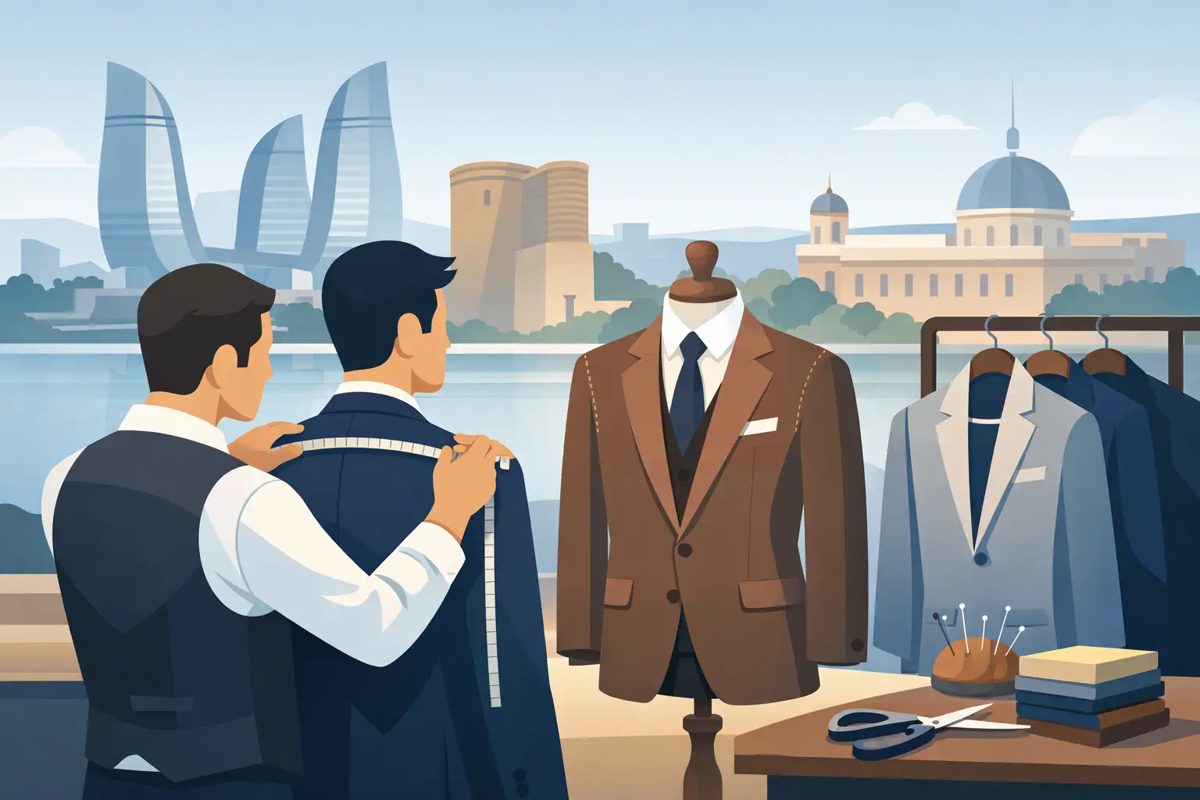
Excess cloth at the shoulder of a ready-made suit, a collar that stands away from the neck, or tension across the seat of the trousers are not minor details. At an executive meeting, an official reception or a private ceremony in particular, these details reveal not the price of the clothing but the standard by which its owner chooses. That is precisely why having a suit made to order in Baku should not be regarded as a mere question of size: it is a wardrobe decision, considered in relation to one's build, one's rhythm of life and the purpose for which the garment will be worn.
In bespoke tailoring, the suit does not force a man into a standard mould. On the contrary, the pattern is shaped according to his shoulder line, his posture, the structure of his neck and the way he moves. The result may look quiet at first glance, but anyone who looks closely understands that this is not ready-to-wear.
Where does the value of a bespoke suit come from?
The quality of a luxury suit is not determined by the cloth label alone. Cloth, cut, construction and the fitting process are inseparable from one another. Even the finest cashmere-blend wool will lose its advantage in a poorly constructed shoulder. In the same way, a good cut cannot preserve its effect for long in a weak material that soon loses its shape.
The principal advantage of a personal commission is not to hide the asymmetries of the body, but to take them into account and create a natural silhouette. One shoulder sitting slightly lower than the other, a back that is flatter or more rounded, the length of the arms, the position of the waist — all of these show on a suit. Ready-to-wear tries to subordinate these differences to an average statistical size. Bespoke tailoring, by contrast, takes them as the starting point of the construction.
This difference is felt particularly by men who travel a great deal, spend the day in meetings or pass long hours at events. A suit must not only look right when standing; when seated, the collar should stay in place, the trousers should not pull excessively at the knee, and the jacket should not restrict movement.
The first decisions when having a suit made in Baku
The most important question at the first meeting is not "which colour?". First it must be established in what circumstances the suit will be worn. A first suit for use in the world of management and finance and a model intended for a wedding, an evening reception or a diplomatic event will not share the same cloth, construction and details.
For the daily working wardrobe, dark navy or charcoal grey is very often the most considered starting point. These tones work with a variety of shirts and ties, look restrained in photographs and under artificial light, and allow transition between the seasons. More expressive choices — light grey, tobacco, olive or subtly checked cloths — usually become more appropriate after the foundation suits are in place.
Whether the jacket has one button or two is also a matter of proportion before it is a matter of taste. The two-button model looks balanced and versatile on most body types. A three-button or double-breasted jacket can create a more formal, more assertive silhouette, but these choices are effective only when the relationships between shoulder, chest and waist are precisely built. Not every fashionable detail suits every build or every professional environment.
The difference between bespoke and made-to-measure
These two concepts are often used interchangeably, although their working principles differ. Made-to-measure is the adaptation of an existing base pattern to the client's measurements. When well applied, this method can deliver a high-level result and make the ordering process more efficient. It is a logical choice for a client whose proportions are close to the standard range and who wants a clear, dependable wardrobe.
Bespoke, on the other hand, involves creating an individual pattern from scratch. Here posture, the angle of the shoulders, the structure of the back, the natural position of the arm and the desired silhouette are each considered separately. More handwork, more fittings and deeper construction work are required. This approach is particularly valuable for non-standard proportions, high expectations, or core wardrobe pieces that will be worn for years.
The choice depends less on the question "which is better?" than on "which level of service and which purpose is right for me?". A correctly measured made-to-measure suit will always look better than a badly made bespoke one.
Choosing the cloth is a broader subject than appearance
The feel of the cloth in the hand is the first impression. How it behaves on the suit is the real criterion. The weight of the cloth, its weave, its drape, its breathability and its response to creasing make a direct difference in the Baku climate, in travel and over long working days.
The collections of mills such as Loro Piana, Dormeuil, Piacenza 1733, Drago, Scabal, Reda and Zegna are not merely recognised names. They offer a variety of characters, distinguished by the selection of fibre, the quality of the yarn, the density of the weave and the depth of the colour. But the most expensive cloth is not automatically the right choice for every commission.
A light, open-weave wool gives comfort in hot weather, but under a very full schedule and frequent travel it can crease more easily. A medium-weight wool usually strikes a more practical balance for year-round wear. A flannel weave looks soft and deep, but it is not the principal suit for a Baku summer. The addition of cashmere can bring a luxurious hand and warmth, yet how the jacket holds its shape under intensive daily use must be assessed separately.
When choosing cloth, it is useful to consider four points together:
- the main season in which the suit will be worn;- the intensity of meetings and travel;- the desired degree of formality;- the existing wardrobe of shirts, shoes and ties. For a first commission, for example, a dark navy, finely textured, medium-weight wool opens up more possibilities for the working day, for dinner and for travel alike. It is not ostentatious, but it is one of the strongest foundations of a long-term wardrobe.
Taking measurements and the fitting stage
Taking accurate measurements does not consist of filling in a table of centimetres. The tailor observes the client's natural posture, whether one arm is more active than the other, how the body moves when the jacket is buttoned, and his habits in wearing clothes. Some prefer a closer-fitting jacket; others want more room across the chest and waist for comfort in the car or the office. Both approaches are right, provided the aim is clear from the outset.
The fitting is the stage at which the true quality of a suit becomes visible. This is when the sit of the collar on the neck, the shoulder line, the sleeve length, the front and back of the jacket and the break of the trousers are carefully checked. Small adjustments are not a flaw in the process; they are the essence of bespoke tailoring. The aim is not a suit that looks tight or excessively "perfect" at first glance, but one that keeps its shape in daily movement and sits naturally on its owner.
The width and length of the trousers also demand separate attention. Excessively narrow trousers, though they try to create an impression of modernity, are uncomfortable when seated and can tire the cloth quickly. Excessively long trousers, meanwhile, pile up over the shoe and weigh down the overall silhouette. The right break is determined together with height, the shape of the shoe and the style of dress.
Details should be quiet but purposeful
Details such as hand-sewn buttonholes, the choice of lining, the appearance of the pockets, the shape of the lapel and a monogram create individuality. But the best result is achieved when these elements do not overshadow the main silhouette. A discreetly contrasting lining, a well-chosen horn button or a sleeve length matched to the shirt cuff gives the suit personal character. An excessively bright lining, multiple coloured stitchings and attention-seeking logos, on the other hand, very often weaken the restrained value of the cloth and the cut.
The aim of a man commissioning a bespoke suit should not be to look the loudest in every room. The more proper aim is to feel comfortable and in place wherever he is. This reads as reliability in a business setting and as quiet self-assurance at a private event.
For Atelier Baku 1984, which unites its tailoring tradition with a selection of European mills, the meeting is not merely the taking of an order. It is the starting point that determines how the suit will serve its owner's daily rhythm and his long-term wardrobe.
A good suit looks like yours from the first day, and as the years pass it becomes the least deliberated, most trusted piece in your wardrobe. So when you choose, look not only at the first impression in the mirror, but at how many important days that suit will represent you with ease.