

How Many Fittings Does a Bespoke Suit Require, and Why?
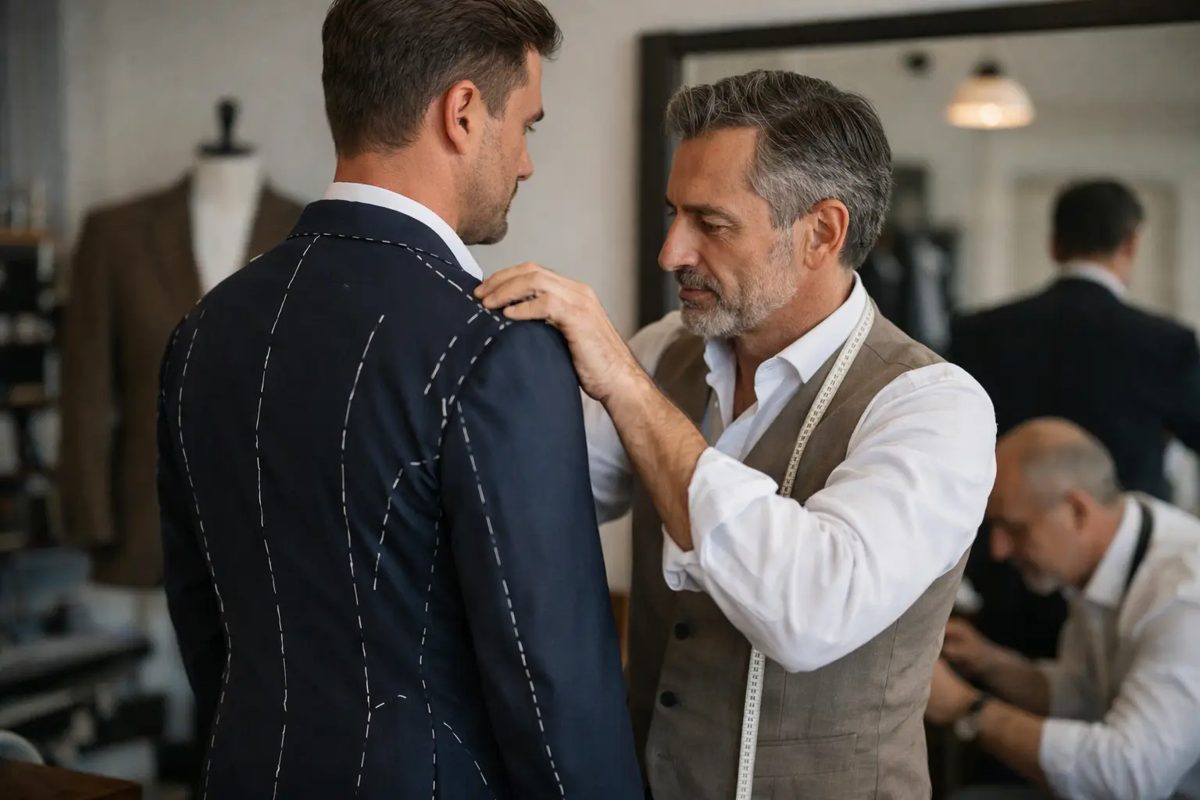
A question often asked at the first meeting is this: how many fittings does a bespoke suit require? The short answer is usually two or three. But the real answer lies in how the suit is adapted not merely to measurements, but to a man's posture, his movement and the way he wears his clothes each day. In a precisely made suit, the number of fittings is not the goal. The goal is a jacket that sits calmly on the shoulder, a collar that hugs the neck correctly, trousers that remain comfortable in stride, and a silhouette that looks natural.
In bespoke tailoring, every commission is built on its own pattern. For that reason, just as two bodies cannot be described by the same size chart, it is not the right approach to promise every client the same number of fittings. Some commissions are completed with two careful checks; in other cases a third fitting settles the final millimetres of the suit.
How many fittings does a bespoke suit require?
For most bespoke suits, the process takes shape around three principal meetings: the initial measuring and style consultation, the baste fitting and the final fitting. Sometimes an experienced tailor schedules an additional check after the first meeting. This does not signify a fault. On the contrary, it is a sign of the attention given to adapting the suit to the body.
Tying the number of fittings to a single figure, especially without regard to the character of the commission, can be misleading. A classic navy business suit, for instance, and a formal two-button jacket made for a wedding, with higher-rise trousers, do not call for the same construction or the same behaviour. The drape of a light Loro Piana wool and the response of a densely woven Dormeuil cloth on the body also differ.
For a client commissioning a bespoke suit for the first time, three fittings are very often a comfortable and logical framework. If the client already has a pattern drafted at the atelier and his measurements have remained stable, subsequent commissions can reach a precise result with fewer checks. Even so, "fewer fittings" does not always mean superior service. The extra time the tailor devotes to you is part of the work done so that the suit keeps its appearance for many years.
The first meeting: not measuring, but reading the silhouette
At the initial meeting the principal measurements are taken: chest, waist, shoulder, sleeve, neck, the seat of the trousers and the inside leg. But the bespoke process is not merely the sum of centimetres. The tailor observes whether one shoulder sits lower than the other, where the natural line of the waist falls, how the client holds himself standing and seated, and in which direction his arms travel in movement.
At this stage the purpose of the suit matters as much as the cut. A suit chosen for daily meetings, for travel abroad or for formal evening events will not have the same construction. A softer-shouldered, lightweight half-lined jacket can be the appropriate choice in the Baku climate and for a working schedule that involves constant movement. A more formal, structured jacket expresses a different standing at a diplomat's reception or a ceremony.
The choice of cloth is assessed here together with the shape. The fineness of Zegna and Reda wools, the character of Scabal cloths and the weave of houses such as Piacenza 1733 affect both the appearance of the suit and its behaviour at the fittings to come. This is precisely why the tailor judges the cloth not as a mere colour swatch, but as a working part of the construction.
The baste fitting: the suit's first dialogue with the body
The second meeting is very often the most important fitting. At this stage the suit is held together with temporary stitches, but is not yet fully finished. When the client puts it on, the intended line of the cut becomes visible on the real body.
The tailor now works on any excess cloth at the back of the neck, the closeness of the collar to the shirt collar, the ease across the chest, the balance of the jacket when buttoned and the cleanness of the shoulder line. Sleeve length is not chosen by the wrist bone alone. The visibility of the shirt cuff, the natural hang of the arm and the way the client uses his arms are all considered together.
In the trousers, the matter is not merely the length of the leg. The comfort of the seat, the line of the hip, the fall below the knee and the amount of break over the shoe are checked. In a classic suit the trousers should look neither overstretched nor pointlessly loose. This stage requires extra finesse particularly where there is an athletic thigh, a more curved waistline or a slight difference between one leg and the other.
With some suits, after the baste fitting the tailor makes small adjustments to the cloth and the suit proceeds directly to the final fitting. In other cases more work on the shape is needed. A marked shoulder asymmetry, an unusual posture, a new jacket model being built for the first time or a cloth with a complex pattern, for example, can justify an additional check.
Why the mirror is not the only criterion
During a fitting the image in the mirror is important, but it is not enough. One must take a few steps in the suit, sit down, stretch the arms forward and fasten the button. Only in movement do tension across the back of the jacket, lifting at the collar or the uncomfortable points of the trousers come to light.
The experienced client also knows the value of coming to this meeting in the shirt and shoes he will wear every day. The height of the shirt collar, the shape of the shoe's toe and even whether or not a belt is worn can change the proportions of the suit. In tailoring, a detail never looks independent; it finds its meaning within the whole silhouette.
The final fitting: not completing, but confirming
At the final fitting the suit is essentially finished. The aim here is not to search for a new cut, but to confirm that the work done gives the right result on the body. The length of the jacket, the position of the buttons, the cuff, the trouser break, the comfort inside and the overall balance are checked one last time.
At this stage even very small changes can affect the result. Shortening a sleeve by a few millimetres, softening the break of the trouser over the shoe or refining the ease at the waist makes the suit look calmer and more expensive. Quality tailoring shows itself not in attracting attention, but in a correctness that goes unnoticed.
In an atelier that works through personal meetings, such as Atelier Baku 1984, the final fitting also completes the client's relationship with the suit. A suit is not made only to look beautiful on a mannequin. It is expected to behave with the same precision on its owner's working day, at his meetings, at his events and on his travels.
Factors that increase or reduce the number of fittings
The number of fittings depends mainly on four factors: the complexity of the commission, the asymmetry of the body, the properties of the chosen cloth and the client's previous pattern history. On a first commission, the tailor is still learning your natural posture, your preference in comfort and the silhouette you favour. For that reason an additional check can be justified.
The weight of the cloth also plays a part. A light, open-weave wool looks more fluid, but it demands a sensitive approach to construction and pressing. A heavier cloth can hold the line more firmly, but may not give the same comfort in hot weather. In both cases, the fitting exists to read the relationship between the cloth and the body.
The client's time is also taken into account, but speed should not come at the expense of quality. When commissioning for a special event, it is a wise decision to allow sufficient time for the fittings and for any small adjustments that may be needed. The best result comes not from the haste of the last day, but from properly planned meetings.
The next time you ask "how many fittings are needed?", think of the result rather than the number. What you need is not a suit delivered as quickly as possible, but a suit that has found its place on your body and creates quiet confidence every time you wear it.