

Bespoke versus ready-to-wear: the essential differences
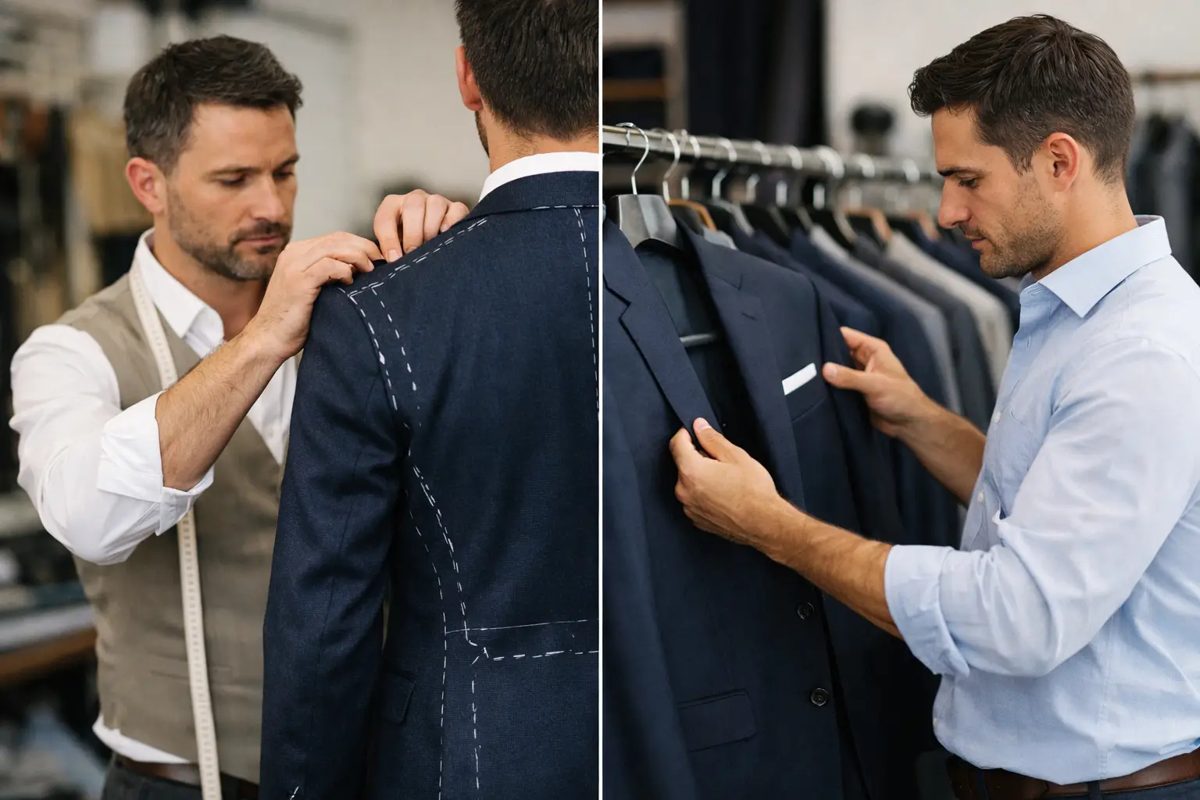
The line a suit creates at the shoulder, the way the collar sits at the neck and how the cloth behaves in movement say a great deal at first glance. That is precisely why the choice between bespoke and ready-to-wear is not merely a question of price or brand. It depends on a man's build, the rhythm of his work, the settings he moves in and what he expects from his clothes.
A ready-to-wear suit, chosen well, can look neat and practical. But the logic of a standard size rests on average body proportions. Shoulder width, chest volume, waistline, arm length and posture differ from one man to the next. Bespoke tailoring treats these differences not as a problem but as the starting point of the cut.
The essential difference between bespoke and ready-to-wear
A ready-to-wear suit is a model made in advance. The client chooses the closest option from the available sizes, and then, if needed, the trouser hem, waist or sleeves are partly altered. This approach gives speed, but the fundamental architecture of the jacket does not change: shoulder construction, armhole, chest shape and balance all remain within the frame of the factory cut.
A bespoke suit, by contrast, is made with the client's measurements and also with his posture and natural asymmetries in mind. One shoulder sitting slightly lower, the shape of the back, a forward or backward stance, a strong thigh line or a slimmer waist — each of these affects how the pattern is built. The tailor does not simply collect numbers; he reads the proportions of the body in motion.
The terms deserve clarity here too. A made-to-measure suit is an existing base pattern adapted to the client's measurements. It gives a more personal result than ready-to-wear. Bespoke is the deeper stage of tailoring, in which the pattern is created from scratch for one particular person. Both options can be of high quality, but the degree of personalisation and the freedom of construction are not the same.
Fit is not merely a question of size
A suit fitting well is not confined to the tension when the button is fastened or the length of the trouser leg. True fit is the jacket resting calmly on the shoulder, the lapel and collar lying against the shirt collar without a gap, the chest not pulling and the jacket not riding up as a whole when the arms move.
In a ready-to-wear suit the chest and waist sometimes fit, yet the shoulder is too wide. In another case the shoulder looks right, but the armhole is low and restricts movement. Later alterations help up to a point, but changing fundamental elements such as the shoulder, the collar and the balance of the jacket is either impossible or puts the result at risk.
In a bespoke cut the first aim is not to "correct" the body but to adapt the suit to it. When the particulars of posture are taken into account, the front and back lengths of the jacket, the angle of the sleeve, the position of the waist and the opening of the skirt are built in better balance. The result is a suit that does not try to attract attention, but looks natural on its owner.
This difference is felt especially at executive meetings, diplomatic receptions, weddings and ceremonies where one spends long hours on one's feet. Comfort is not the enemy of appearance. With the right construction, the suit remains as disciplined at the end of the day as it was in the first minutes.
Choosing cloth is about more than looks
The name of a cloth alone is no verdict on quality. The composition of the fibre, the density of the yarn, the type of weave, the weight and the mill's finishing method determine how the suit behaves. Two dark blue cloths of the same shade may look alike from a distance, but one will crease quickly over the day while the other holds its shape more steadily; one will feel heavy in the summer heat while the other breathes.
In ready-to-wear suits the choice of cloth is tied to production scale and price targets. Even where good wool is used, the client has limited scope to decide according to climate, frequency of wear and personal preferences in touch. The advantage of ready-to-wear is that the suit can be seen, touched and taken home the same day.
In a bespoke order, the cloth is chosen in light of the suit's purpose. A suit intended for the office every day and a suit made only for evening events should not share the same weight and weave. In the Baku climate, a mid-weight wool may be most appropriate for four-season use, a weave with greater crease resistance for travel, and an open-weave cloth for summer ceremonies.
The collections of mills such as Loro Piana, Dormeuil, Piacenza 1733, Drago, Scabal, Reda and Zegna make exactly these fine distinctions possible. But the most expensive cloth is not the right cloth for every situation. A very fine, high-super wool can feel exceptional to the touch, yet be more delicate in a suit worn daily in the car, the office and on the road. Value lies not in the label of the cloth but in how well it suits its purpose.
Construction is the suit's inner character
The outward appearance of a suit matters, but the inner layers that hold its shape make the deeper difference. Fused construction speeds up production and keeps the price under control. Properly applied, it can look neat at first. But time, heat and dry cleaning can affect how those layers behave.
Half-canvas and full-canvas construction, by contrast, give the chest of the jacket a more natural shape. In this method the inner layers adapt to body heat and movement, and over time the jacket behaves ever closer to its owner's posture. Hand stitching, the shaping of the lapel and the working of the chest piece are the unseen but perceptible side of tailoring.
This does not mean that everyone should choose only a full-canvas jacket. For a suit that is worn rarely and bought for a specific occasion, a well-made ready-to-wear model can be a sensible choice. But if the suit is the mainstay of a professional wardrobe, the durability of the construction and its relationship with the body take on far greater importance.
How do time, budget and purpose decide?
The ready-to-wear suit has a practical advantage: it offers a quick solution for an urgent trip, an event close at hand or a specific colour missing from the wardrobe. Budgeting is also clearer, because the cost of the garment and of alterations is known in advance. If the body's proportions are close to standard sizes, a professional alteration can achieve a perfectly good result.
Bespoke, on the other hand, takes time. The first consultation, the taking of measurements, the choice of cloth, the interim fitting and the final adjustments are a natural part of the process. This is not lost time; it is the attention given so that the suit serves not just for the first wearing but for years. The client speaking openly about his weight, his daily movement and his habits of dress makes the result more precise.
Measuring the budget by the initial sum alone does not give the full picture either. A suit made with a quality cut and a cloth suited to its purpose is worn more often, causes less discomfort and does not become a random item in the wardrobe. Even so, a bespoke suit is not the obligatory answer for every situation. For travel, rainy days and more casual use, a well-chosen ready-to-wear suit can have its own place.
Which questions are worth asking in a bespoke order?
When going to meet a tailor, there are questions more useful than "which is the best cloth?" How many times a week the suit will be worn, whether it will mainly be used in the office, in the car, at ceremonies or on the road, and which shoes and shirts it will be combined with — all of these bear directly on the decision. Even whether the jacket should be more structured or softer in the shoulder is tied to personal style and way of life.
For a bespoke tailoring house such as Atelier Baku 1984, this dialogue is as important as the measuring. A precise result does not come from centimetres alone; the client's daily rhythm, his taste and the feeling he expects from the suit all enter the cut. That is why choosing a dark navy or charcoal grey for a discreet working wardrobe, or a more expressive texture for a special day, calls for a different approach.
A good suit does not enter the room before you. It keeps attention on your face as you speak, does not restrict your movement and, at close range, lets the level of the material, the cut and the care given to the details be felt. When choosing, the truest criterion is this: the suit should not merely look right on you; it should look as though it had always been meant for you.