

Why is a seven-fold tie in Como silk different?
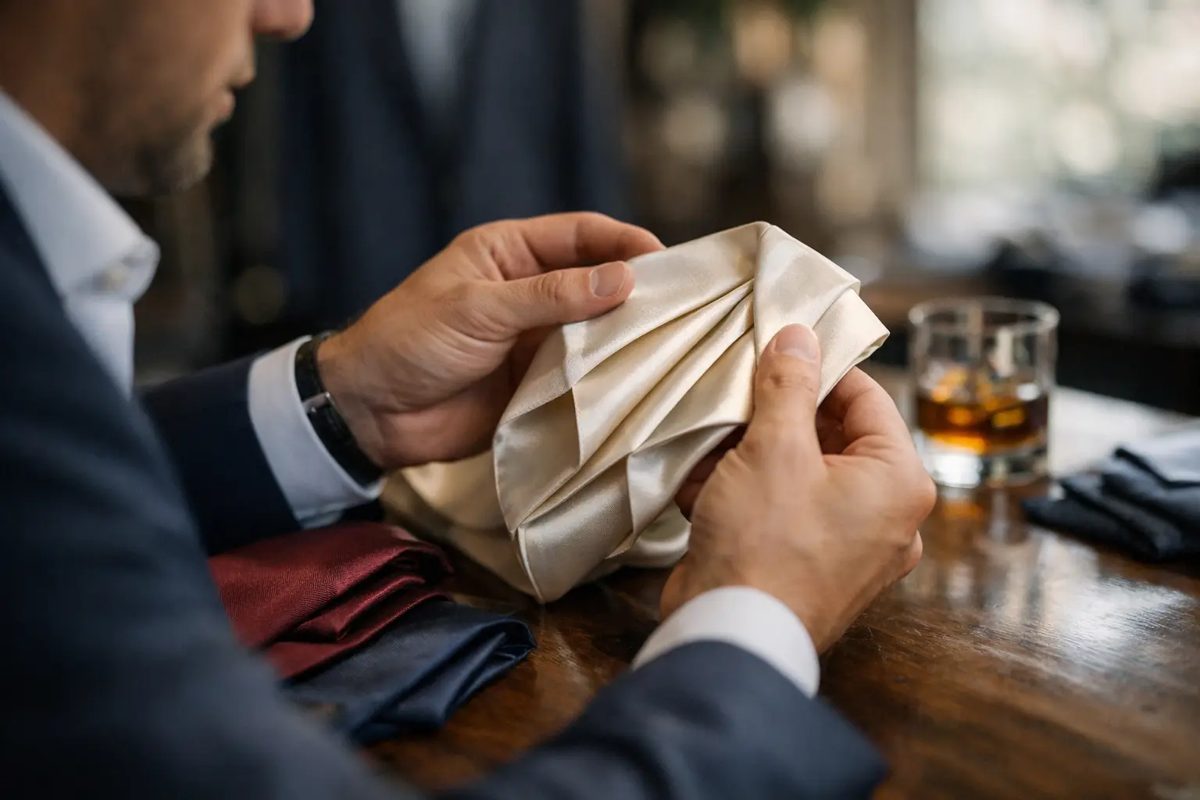
The worth of a tie may appear at first glance in its pattern, but true quality is felt in its weight in the hand, in how it responds as the knot is tied and in how it holds its shape at the end of the day. A seven-fold tie in Como silk is chosen precisely for these silent differences. It is not simply an accessory that adds colour to a suit; it is a precise detail in the dress vocabulary of a man who understands cloth, construction and personal style.
Unlike mass-produced models, a seven-fold tie takes its shape not from an inner lining but from the folding of the silk itself. This method requires more fabric, a more exact cut and the strict supervision of the maker. The result is a tie that looks light yet feels full to the touch, moves naturally and is expressive in the knot.
What is seven-fold construction?
The term seven-fold refers to the tie's silk being folded and built on the principle of seven folds. In a classic lined tie, a separate interlining that gives the shape sits inside the outer silk. In a seven-fold model, the layers of fabric themselves perform that role. The construction is therefore more sensitive both to the quality of the material and to the precision of the cut.
The main advantage of this technique is that the tie behaves in a livelier way. A well-made model does not stiffen excessively when the knot is tied, yet it does not look loose or uncontrolled either. It sits on the line of the neck by its own weight. With the soft-shouldered, natural-chested construction of a hand-tailored suit in particular, this balance is felt at once.
That said, seven-fold should not be regarded as automatically the right choice for every situation. If too thick a fabric or too wide a cut is chosen, the knot may look excessively bulky. For shirts with narrower collars, a slender build or very formal daily business dress, the weight of the fabric, the width and the type of knot should be considered in advance. A luxurious construction shows its advantage only in the right proportion.
What makes a seven-fold tie in Como silk different
The Como region of Italy has for many years been one of the most respected centres of silk weaving. Here a fabric is judged not only by its colour or pattern but by the choice of fibre, the density of the weave, the depth of the dye and how the surface reflects light. For a tie these qualities matter especially, because the silk is constantly folded, unfolded and seen in the light throughout the day.
Como silk usually gives greater depth in its colour transitions and a more restrained lustre on the surface. A fine grenadine, shantung, twill or printed silk can create a different character with the same suit. A dark blue grenadine, for instance, leaves a serious but not cold impression at a business meeting. A patterned printed silk adds a personal signature to the look at a dinner, a reception or a more private occasion.
Because more fabric is used in the seven-fold structure, the quality of the silk cannot hide. A material with a weak surface, one that is too thin or unstable in colour cannot carry the beauty of the construction. That is why Como silk here is not merely an indication of origin but the main factor that determines the tie's shape, drape and long-term behaviour.
The character of the knot
The knot of a tie is a small but unmissable focal point in a man's style. In a seven-fold model the knot looks more sculptural thanks to the layers of fabric. Tied correctly, the slight hollow beneath the knot — the dimple — gives the tie depth and shows the play of light on the silk more clearly.
The type of knot matters here. The classic four-in-hand preserves the natural asymmetry and softness of a seven-fold tie. The more symmetrical Windsor may be appropriate with wide-collared shirts, but in a thick silk it can create unnecessary bulk. The choice depends on the shirt collar, the width of the tie and the structure of the face. The same tie does not give the same result with the same knot on every man.
Proportion with the suit and shirt
A high-quality tie is not judged on its own. Its width should relate to the width of the jacket's lapel, and its length to the waistline of the trousers. In the modern classic wardrobe a width of roughly 8–8.5 centimetres creates a reliable balance for most builds and for jacket lapels of medium width. A wider lapel and a larger frame can carry a slightly broader tie; a jacket with slim lapels calls for a more controlled proportion.
Colour choice is not merely a question of matching either. With dark grey and charcoal suits, burgundy, dark green, navy and brown tones create a deep, mature combination. With blue suits, a light blue shirt and a silk tie in dark red or chocolate works especially well. A white shirt allows more freedom, but it is wise to soften the severity of the look with the texture of the tie.
The scale of patterns should be considered as well. A tie with a small geometric pattern can be worn with a striped shirt, but the size and direction of the patterns should not compete with one another. When in doubt, a textured but plain-coloured Como silk is the most reliable choice. A tie of this kind finds its place both at daytime meetings and at evening invitations.
Who is a seven-fold tie for?
This construction is for men who value quality that is felt over a logo that is seen. Its appeal is not ostentatious. Someone who knows ties will notice the drape of the fabric, the depth of the knot and the cleanness of the edges; someone who does not will simply sense that the wearer has dressed with care.
At executive meetings, diplomatic receptions, wedding ceremonies, special dinners and in settings where personal presentation matters, a seven-fold tie creates a genuine advantage. But its value is not limited to formal occasions. A well-chosen dark blue or brown model can become a permanent part of the daily business wardrobe with a high-quality wool suit and a well-fitted shirt.
For a man ordering bespoke tailoring in Baku, it is more rational to consider the tie together with the suit. When the shape of the jacket's lapel, the spread of the shirt collar, the client's height and his preferred knot are all taken into account, the result looks more natural. At Atelier Baku 1984, choosing this detail in keeping with the overall proportion of a bespoke suit serves exactly that purpose.
Care and longevity
A seven-fold tie looks delicate, but with the right care it can be worn for many years. The main rule is not to pull the knot open at the end of the day. Undo it calmly, in the reverse order of the way you tied it. This habit reduces the strain on the silk fibres and preserves the tie's shape better.
After wearing, rather than hanging the tie at once on a narrow hanger, letting it rest for a few hours on a flat surface or on a wide tie hanger gives a good result. When travelling, fold it loosely or keep it in a tie case designed for the purpose rather than rolling it tightly. Small creases mostly fall out on their own after a short time in a steamy bathroom. Direct ironing, however, can damage the surface of the silk and alter its lustre.
In the event of a stain, intervening at home with water or a chemical agent is risky. Especially on printed silks, colour bleeding and water marks can be permanent. In such cases a professional cleaning service with experience of silk articles is the wiser choice.
The value of a good tie becomes clearer not on the first day but over time. Well-chosen Como silk, a considered seven-fold construction and a proportion suited to its owner's build turn a single detail into the quiet yet convincing signature of personal style.