

Choosing a tailor: the unseen difference in a suit
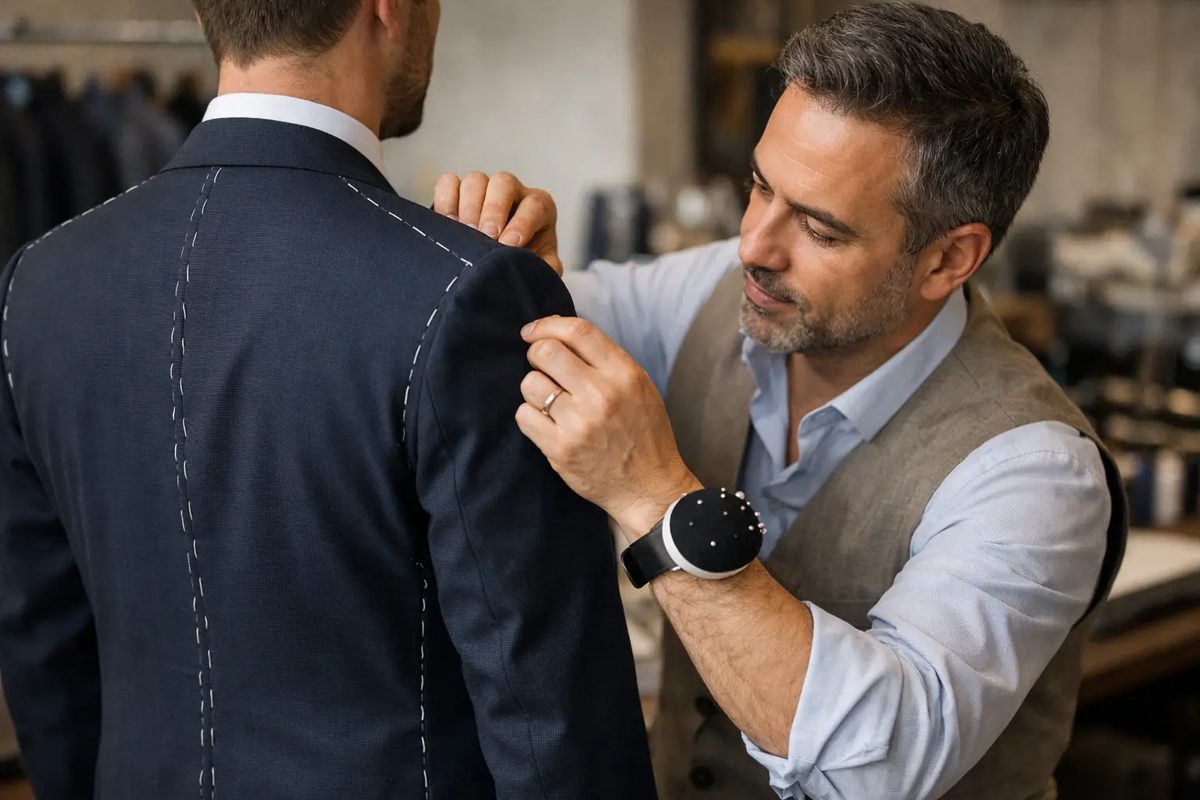
A small crease forming at the shoulder of a ready-to-wear suit, the collar standing away from the neck or trousers losing their shape as you walk may seem trivial at first glance. For an experienced tailor, however, these are precise signals about the structure of the body, the behaviour of the cloth and the quality of the cut. A true bespoke suit begins with reading those signals.
In a man's wardrobe the suit is not simply formal dress. In the meeting room, at a diplomatic reception, at a private ceremony and in the rhythm of daily work, it expresses a man's attitude to himself. Good tailoring is therefore not only a matter of recording measurements; it is the art of understanding the silhouette, choosing the right construction and creating a garment that keeps its value over time.
What the tailor sees, and what the client feels
A professional tailor's first task goes well beyond taking body measurements. The natural slope of the shoulders, the carriage of the neck, the shape of the back, the position of the arms, the waistline and habits of movement all influence the construction of the suit. Two men with the same chest measurement rarely get the right result from a jacket of the same cut.
The client may not always be able to name these technical details, but he feels the result immediately. The jacket rests calmly on the shoulder, the collar sits close to the shirt collar, the chest is not pinched when the button is fastened, and the sleeve length does not slip during gestures. The trousers neither narrow too tightly over the leg nor gather excess cloth. Comfort here does not mean looseness. Comfort means a garment that does not hinder the body, yet whose shape stays clearly defined.
Good tailoring also takes the client's way of life into account. For an executive who spends most of his day in the office, freedom of movement and the cloth's resistance to creasing come to the fore. Someone who often attends formal events may choose a more expressive shoulder line, a deeper colour and a texture that shows its character in evening light. The tailor's job is not to offer a ready recipe, but to translate a man's needs with taste.
The difference between bespoke and made-to-measure
These two concepts are often used to mean the same thing, but there is an important difference between them. In the made-to-measure process an existing base pattern is adapted to the client's measurements. Compared with ready-to-wear this gives a more accurate fit and a wider range of choice. For a man who is short of time but unwilling to compromise with standard sizes, it can be a sensible option.
In bespoke tailoring, the pattern is drafted directly for the client. The cut, the balance, the shoulder construction, the lapel shape and the asymmetries of the body are each considered separately. The process requires more meetings, more fittings and more intervention by the master. In return, the suit does not merely conform to measurements; it takes shape around its owner's posture and movement.
The choice here is not a matter of one being absolutely superior to the other. For a client renewing his wardrobe in stages and looking for a practical business suit, a quality made-to-measure may well suffice. A more complex build, a special occasion, a principal suit to be worn for years or a high sensitivity to a personal cut justify the bespoke approach.
Taking measurements is not just numbers
Measurements are only the beginning of the process. An experienced master assesses the front and back balance of the jacket, the natural fall of the sleeve, the position of the button and the rise of the trousers together. For a tall man, for instance, a slightly higher button position can make the body look better proportioned. For a client with a short torso, the length of the jacket and the placement of the pockets can be decisive for the balance of the silhouette.
This is why the fitting stage matters. The cloth is still in an unfinished state, but it is precisely now that small corrections can be made. The master's work is not to force the cloth onto the body, but to show the body's natural line more precisely.
The choice of cloth defines the suit's character
The same pattern can look and feel entirely different in two different cloths. The weight, weave, twist, elasticity and surface texture of the cloth change both the visual behaviour of the suit and its comfort in wear. Choosing a cloth is therefore not as simple as picking from a colour catalogue.
Mills such as Loro Piana are distinguished by softness, fine weave and the high quality of their natural fibres. Dormeuil offers broad seasonal possibilities and refined formality. Scabal is known for deep, serious and expressive cloths for the classic business wardrobe. Zegna, Reda, Drago and Piacenza 1733 allow precise choices between different weights, textures and scenarios of use.
Given the climate of Baku in the summer months, lightweight wool, wool-silk blends and breathable open-weave cloths may be more suitable. But a very thin cloth is not always the best choice. Its shape may soften sooner and it may prove more delicate in intensive daily wear. For a working wardrobe, a mid-weight, quality wool often gives the more rational result, both in neatness of appearance and in durability.
The same restraint applies to colour. Dark blue, charcoal and mid-grey suits form the foundation of a wardrobe because they combine easily with different shirts and ties. Lighter grey, tobacco, olive or subtly checked cloths are the later choices for broadening personal style. In a first suit, looking right in every setting is worth more than standing out.
Construction: the unseen architecture of the jacket
The value of a suit is not measured by the label of its cloth alone. The construction inside the jacket determines how it will sit on the body and how well it will keep its shape over the years. In a full-canvas construction the natural layers help the jacket adapt to its owner's body over time. This method demands more handwork and attention, but the result is livelier and more natural.
A half-canvas construction, when well made, strikes a successful balance for daily wear. In business suits especially, it can be the right solution between lightness, shape and reasonable practicality. Fused construction is a faster and more affordable method of production, but heat, intensive wear and the passage of time can limit how well it holds its shape.
The shoulder construction also changes the language of the silhouette. A soft Italian shoulder looks more natural, relaxed and fluid. A more structured shoulder creates a formal, firm and authoritative impression. Which is right depends not on trends but on the client's build, his profession and the settings in which the suit will be worn.
Details are not there for show
Hand-worked buttonholes, a chosen lining, functional cuff buttons and fine lines of stitching can express the level of the tailoring. But these details lose their meaning when they serve only for display. Elegance is felt when a person does not think about how intricately the suit was made, but simply sees how well it sits on its owner.
The choice of shirt and tie completes this whole. In a bespoke shirt the collar shape should suit the structure of the face, and the choice of cuff the manner of use. A seven-fold tie made from Como silk brings the volume of the knot, the fall at the neck and the depth of the fabric to a different level. Such a detail gains value only when it harmonises not just with the suit, but with the taste of the man who wears it.
How to approach the first meeting with a tailor
It helps to come to the first meeting with a clear idea, but rigid preconceptions are not necessary. Saying openly in what circumstances you will wear the suit, how much you move during the day, which colours predominate in your wardrobe and how you wish to look gives the more accurate result. Reference pictures can indicate a direction, but not every cut has the same effect on every body.
A good atelier will not approve every wish of the client exactly as stated. Where necessary it will suggest a more correct collar height, a more suitable cloth weight or a quieter detail. This is not interference with taste; it is the responsibility of craftsmanship. In a tailoring house built on personal consultation, such as Atelier Baku 1984, the value of the process arises precisely from this dialogue.
When ordering your suit, think of it not as a decision for one season but as a long-term element of your wardrobe. When the right tailor, the right cloth and a cut that belongs to you are chosen together, the suit quietly preserves, years later, the impression it made at the first meeting.