

A guide to commissioning a bespoke jacket
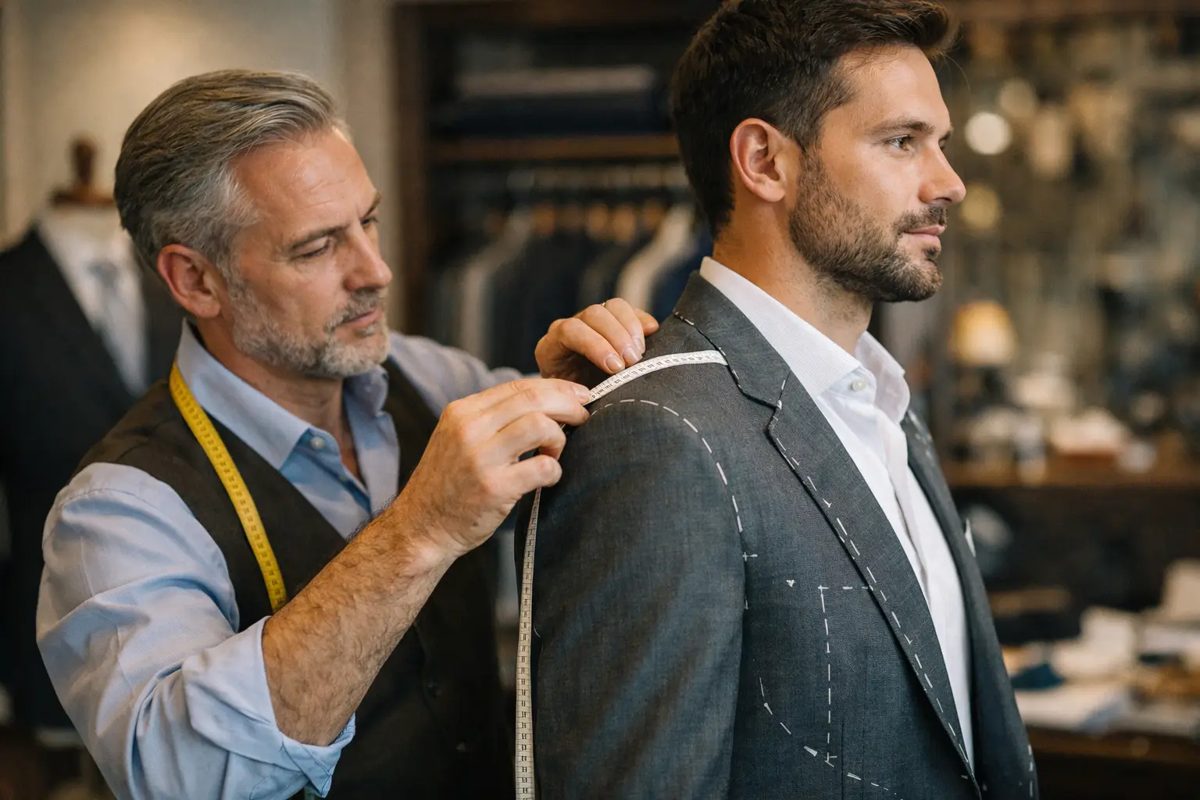
A jacket that extends a millimetre too far past the shoulder, a lapel that gapes at the neck, a front that pulls across the stomach when buttoned — each of these is outwardly small, yet each defines the overall impression. A guide to commissioning a bespoke jacket exists precisely so that these details are not left to chance. A properly commissioned jacket does not merely look good; it answers to the way its owner moves, to the rhythm of his working day and to his personal style.
Ready-to-wear clothing is, more often than not, cut for a statistically average body. Yet shoulder width, waistline, the shape of the back, arm length and posture differ from one man to the next. In bespoke tailoring the aim is not simply to take measurements. The aim is for cloth, construction and cut to form a single, natural whole on the body.
Where should a bespoke jacket commission begin?
The first meeting is not only about choosing a colour and a model. It is essential to establish precisely where the jacket will be worn: the everyday office, important negotiations, travel, an evening reception, or a special occasion such as a wedding. This one question shapes every decision that follows, from the weight of the cloth to the choice of buttons.
In the hot months in Baku, for instance, a heavy, densely woven wool may look elegant yet prove an uncomfortable choice for daily wear. On the other hand, a very light cloth may not hold the shape required of a jacket with a serious structure. The right choice always arises from the balance between frequency of use, climate and personal comfort.
It helps to arrive at the first consultation with a clear picture of your existing wardrobe. The colour of the trousers you wear most, the shirt collars you prefer, your style of shoe and the dress code of your working environment all make it easier to integrate the jacket later. A good jacket is never judged on its own — it has to work with the other pieces in the wardrobe.
The silhouette, not the measurements, is what matters
In a bespoke jacket the measurements are the starting point, not the result. Chest, waist, sleeve and length are recorded, but the cutter does not stop there. Whether the shoulders sit forward or back, whether one shoulder is higher than the other, the structure of the back, the natural position of the arms and even the way a man walks must all be taken into account.
The shoulder of the jacket should end exactly where your own shoulder ends. An overly wide shoulder line looks tired and untidy, while a narrow one restricts movement. Across the chest the cloth should not pull, yet neither should it create excess volume that leaves the torso shapeless. A light, natural line when buttoned is normal; sharp tension means the cut needs to be reconsidered.
The length of the jacket is not settled by a simple rule either. The classic proportion is linked to the point where the fingers naturally end, but the proportions of the body and the chosen style matter more. On a tall man an overly short jacket can upset the balance, while on a more compact frame a slightly shorter, well-judged length can make the silhouette look more agile. Here a sense of proportion counts for more than any passing fashion.
How does construction affect comfort?
The parts of a jacket that cannot be seen from the outside determine how it behaves on the body. A fully fused construction may be quick to produce, but over time it can turn stiff, bubble and look unnatural. A half-canvas or full-canvas construction, by contrast, allows the cloth to sit more alive over the chest and to mould itself to the wearer's body with use.
Full canvas is not automatically the only correct answer for every commission. For a lighter, travel-oriented jacket worn in hot weather, a lighter construction may make more sense. The essential point is to match the construction to the weight of the cloth, the intended use and the expected degree of formality.
Choosing cloth is about far more than appearance
The colour of a cloth makes the decision easier at first glance, but its composition, weight, weave and density deliver the longer-lasting result. High-quality wool is among the most reliable choices in terms of breathability, recovery from creasing and year-round wear. The collections of cloth houses such as Loro Piana, Dormeuil, Piacenza 1733, Drago, Scabal, Reda and Zegna offer wide scope for the client who can feel these differences.
A very fine Super number is not the sole measure of a cloth's quality. A wool of very high fineness, for example, may feel extraordinarily soft to the touch, yet prove more delicate under a busy schedule, frequent travel and daily wear. A wool of moderate fineness with a good twist, on the other hand, holds its shape better and stays neat for longer.
Dark navy is one of the wisest starting points for a bespoke jacket. It pairs easily with grey flannel, beige cotton, dark denim and a range of shirt tones. Charcoal grey reads as more formal and restrained. Textured mid-grey, brown or olive tones are a choice with character for the man whose wardrobe already holds its essential jackets.
Restraint in matters of pattern is not a lack of taste but foresight. A fine herringbone, a quiet micro-pattern or a subtle check gives depth at close range while keeping its discretion from a distance. Large checks and high-contrast patterns draw the eye, but they can narrow the range of occasions on which the jacket can be worn.
The purpose of the details of the cut is not display
Lapel shape, the number of buttons, the type of pocket and the choice of vents define the character of a jacket. A two-button jacket with a notch lapel of medium width is a dependable classic for a great many settings. A peak lapel looks more expressive and more formal, but, especially on a first commission, its compatibility with the client's everyday style should be considered.
Patch pockets create a more relaxed, urban mood that suits textured cloths. Flap pockets are the more universal choice for business and formal wear. Two vents at the back give ease of movement and help the jacket keep its shape when seated. A single vent may look more classic, but it does not always offer the same ease for the dynamics of daily life.
Details such as working cuff buttons, visible hand-stitching or a contrasting lining can express personal taste. But the most convincing sign of quality is not visible display. A collar that sits correctly on the neck, a sleeve that falls naturally and cloth that lies calm across the chest are the more valuable indicators.
Why is the fitting not a formality?
After the first cut, the fitting is one of the most important parts of the commission. The jacket must be checked on the body in motion: sitting, reaching forward with the arms, standing and talking, and with the front buttoned. A static view in the mirror is not enough, because the jacket moves with you throughout the day.
At this stage the client's candid feedback is valuable. Tension under the arm, pressure at the neck, discomfort when seated or the feel of an unfamiliar silhouette should all be mentioned. Sometimes the correct structure of a new jacket can feel different at first to a man accustomed to the loose ease of ready-to-wear. That difference, however, must never amount to pain or restriction.
In an appointment-based tailoring model such as that of Atelier Baku 1984, the fitting is not merely a technical correction; it is the stage at which the commission is adapted to its owner's way of life. The observations of the cutter and the real sensations of the client come together here.
How should the jacket be cared for after the commission?
The life of a good jacket depends on how it is worn. Rather than wearing the same jacket on consecutive days, it is better to give the cloth time to rest. A jacket kept on a good-quality, wide-shouldered hanger after wear holds its shape far better.
Turning to dry cleaning for every small mark or crease can weaken the natural properties of the cloth. Airing, a soft brush and professional cleaning only when necessary is the more measured approach. Where the jacket has been made with matching trousers, wearing the two pieces in balance prevents a difference in colour from developing.
Choosing a bespoke jacket is not an attempt to make an impression for a single season. With precise measurements, a considered cloth and restrained details, it becomes a trusted part of your working life and your special moments over the years. The right beginning is to come to the first meeting unhurried, having decided not what you will wear, but how you wish to look and how you wish to feel.