

How should a classic suit fit?
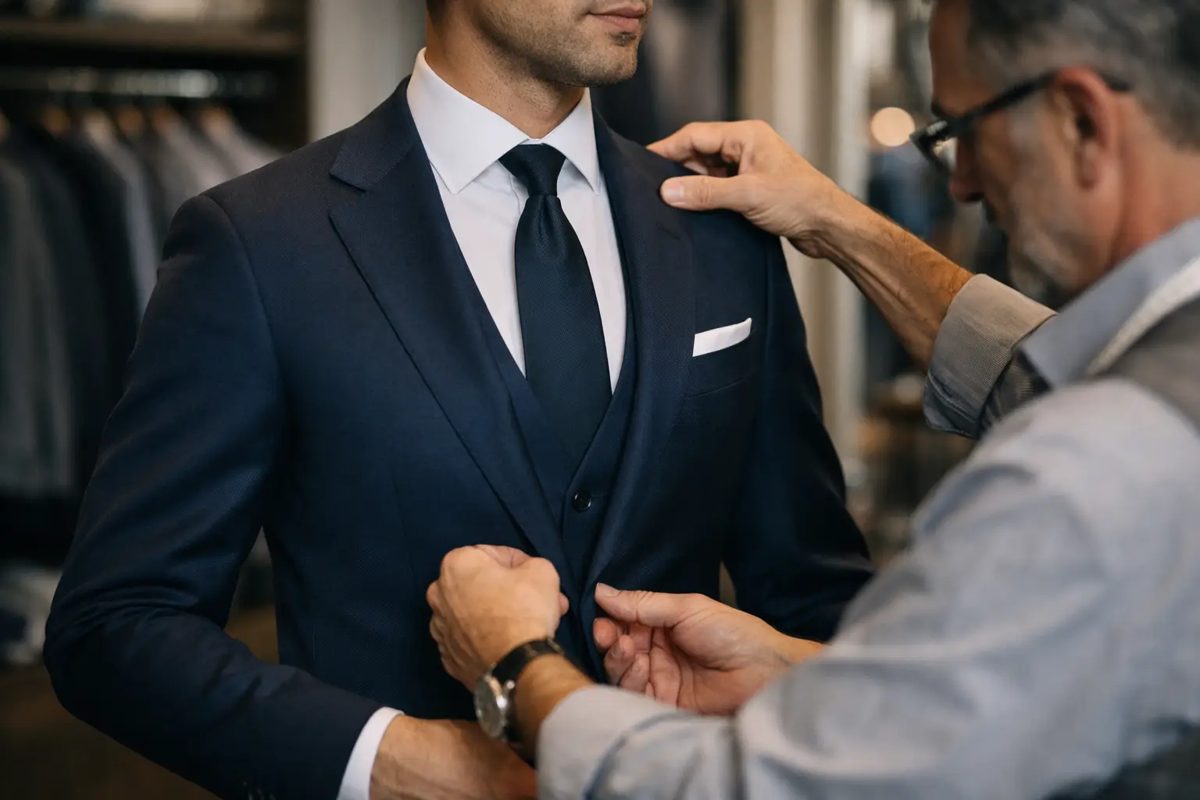
The price of a suit, its cloth and its label may catch the eye at first glance. But to an experienced eye, the strongest signal is the correct fit of a classic suit. A millimetre of excess at the shoulder, a collar that gapes at the neck or trousers that pull when you sit can undermine even the finest Loro Piana or Dormeuil cloth. Conversely, a suit that is in true dialogue with the body looks calm, natural and assured.
A correct fit does not mean looking tight. The aim is not to constrict the body but to clarify its proportions, preserve freedom of movement and present the silhouette in good order. This balance depends on a man's build, his daily movement, the purpose the suit will serve and the character of the chosen cloth.
The correct fit of a classic suit begins at the shoulder
In tailoring, the shoulder is the architecture of the suit. The shoulder seam of the jacket should end precisely where the natural shoulder bone ends. If the seam hangs down over the arm, the jacket is too large; if it sits inside the shoulder and creates strain across the upper back, the cut is too narrow. This flaw is difficult to correct afterwards, and sometimes impossible.
The shoulder line differs with every man's posture. Some clients have square shoulders, others more sloping ones. Nor is it unusual for one side to sit lower than the other. Ready-to-wear clothing rarely takes these differences into account. In bespoke tailoring, the padding, the setting of the sleeve and the slope of the shoulder are built for that particular body. The result is a more natural, more comfortable and more precise silhouette.
The collar should hug the neck, not grip it
The jacket collar should sit quietly beneath the shirt collar. If there is a gap at the back of the neck, if the collar stands away from the shirt or if there is rippling at the front, the problem may not lie in the size alone. Posture, shoulder balance, the shape of the chest and the back length of the jacket all influence this picture.
This detail is especially visible during a meeting. If the collar lifts away when a man sits, turns his head or speaks across a table, the suit is not adapting to its owner's movement. A properly made jacket frames the neck but never chokes it.
Comfort at the chest and the waist is possible at the same time
When the jacket is buttoned, no horizontal lines of tension should appear across the chest. At the same time, the chest should not hang loose and collapse forward. A gentle, natural shape around the button is normal, but if the cloth is pulling, the jacket is too close to the body.
At the waist, the aim is a shape that is refined but never forced. A jacket that is too wide weighs the silhouette down and loses the order of the shoulders. A waist that is too tight makes itself felt immediately when you stand up, get into a car or sit down at the dinner table. For a man who wears a suit for long hours through the working day, comfort is not a separate matter from aesthetics — it is their continuation.
Single-button and two-button jackets produce different effects at the waist. The two-button model creates a more classic and universal balance. The single-button cut offers a more open chest line and can give a more elegant expression for evening occasions. The choice should be made not merely by fashion but by the proportions of the body and the context of use.
The length of the jacket defines the proportion
There are simple rules about jacket length, but not every rule applies to every body in the same way. In the traditional classic measure, the jacket covers the seat, and when the arms hang freely at the sides, the hem falls roughly to the middle of the thumb. This length shows the legs and the torso in proportion.
A shorter jacket can look modern, but on a tall man or one with a long torso it can upset the proportion. An excessively long model creates a heavy impression, especially on men of medium height. Here one must look in the mirror not only at the front view but at the side and back angles as well. The character of a suit reads more clearly in movement.
Sleeve length is an equally delicate matter. Usually 1–1.5 centimetres of shirt cuff should show beneath the jacket sleeve. This is not an immutable law: a larger watch, the shape of the shirt cuff and the length of the arm can change the result. But a cuff that disappears entirely, or shows far too much, disturbs the overall proportion.
The fit of the trousers is not measured at the hem alone
The waist of the trousers should not depend on the belt. It should rest comfortably yet securely on the hips. A belt should work as an accessory that completes the look, not as the thing that holds the trousers up. If the trousers slip down at the waist, if excess cloth gathers at the seat or if deep creases form across the thighs, the measurements or the cut need to be reconsidered.
For a correct fit, the seat is particularly important. When that area is too tight, the cloth pulls, the seams look strained and sitting and standing become uncomfortable. When it is too wide, the rear view loses its neatness. In bespoke tailoring, the shape of the seat, the volume of the thigh and the stance of the legs are assessed separately.
How the trouser hem breaks over the shoe also changes the style of the suit. A full break looks more traditional, but in a heavy cloth and on a shorter man it can visually shorten the legs. A slight break is most often the best-balanced choice. A shorter hem with no break looks elegant and modern, but it does not suit every setting or every shape of shoe. Personal taste matters in this choice, but taste should be supported by proportion.
Cloth influences the fit
The same cut behaves quite differently in different cloths. A lightweight Super 130s wool can appear to flow over the body, while a densely woven Scabal or Zegna cloth gives a sharper line and a more formal appearance. A material with a cashmere blend is soft to the touch, but its drape can differ from that of a classic business suit.
In the Baku climate, the choice of cloth is also a practical matter. In the warm months, open-weave, breathable wool, wool-silk or wool-linen blends offer comfort. That said, the natural creasing of linen is not a flaw but its character. For a man who expects a crisp and faultless line every day, a high-twist wool may be more suitable.
The weight of the cloth should be considered together with the construction of the jacket. A very rigid construction on a lightweight cloth may not look natural. A soft-shouldered, half-lined or light canvas construction can be the more comfortable choice in hot weather. The right decision is made not by looking at the cloth book alone, but by feeling the cloth in the hand and imagining it on your body.
Five positions to check in front of the mirror
Assessing a suit only while standing straight is not enough. The true fit reveals itself in everyday movements. During a fitting, stand up, sit down, stretch your arms forward, lower your head as if to look at your phone and take a few steps. These simple movements say a great deal about the balance of the jacket's shoulders, collar and chest.
The following signs call for attention:
- A ridge or a hollow at the shoulders, or deep folds in the sleeve - The collar standing away from the neck and a gap forming at the back - Lines of strain across the chest and waist when the jacket is buttoned - Tension at the thigh and seat of the trousers when sitting - A hem that gathers uncontrolled over the shoe, or stops far too short
One of these signs does not always mean that the suit has failed entirely. A slight fold in the sleeve, for example, may be the result of the arm's natural movement. What matters is the direction of the crease, its depth and the overall ease the suit gives in movement.
The difference between ready-to-wear, made-to-measure and bespoke
A ready-to-wear suit is based on a certain standard proportion of the body. With minor alterations it can give a good result, especially when the body's proportions are close to the standard size. But when there are differences such as sloping shoulders, the shape of the neck, one shoulder sitting lower, strong thighs or long arms, compromises become unavoidable.
The made-to-measure model adapts a chosen base pattern to personal measurements. For many men this gives a noticeably better result and widens the choice of cloth and details. Bespoke is the more individual approach, in which the pattern is built from nothing for a specific body and the balance is refined step by step over several fittings.
At Atelier Baku 1984, taking measurements is not merely a matter of recording numbers. Posture, habits of movement, expectations of the garment and the behaviour of the chosen cloth are all part of the same process. This approach is valuable not so that the suit makes an impression in the first moment, but so that it remains right on its owner over the years.
A good suit does not shout to show itself off. It rests quietly on the shoulder, holds its place at the collar, does not restrict its owner when he sits and finds its shape again when he stands. When choosing your next suit, look in the mirror not merely at the size, but at the precision you feel in movement.