

The finer criteria for choosing the right suit lining
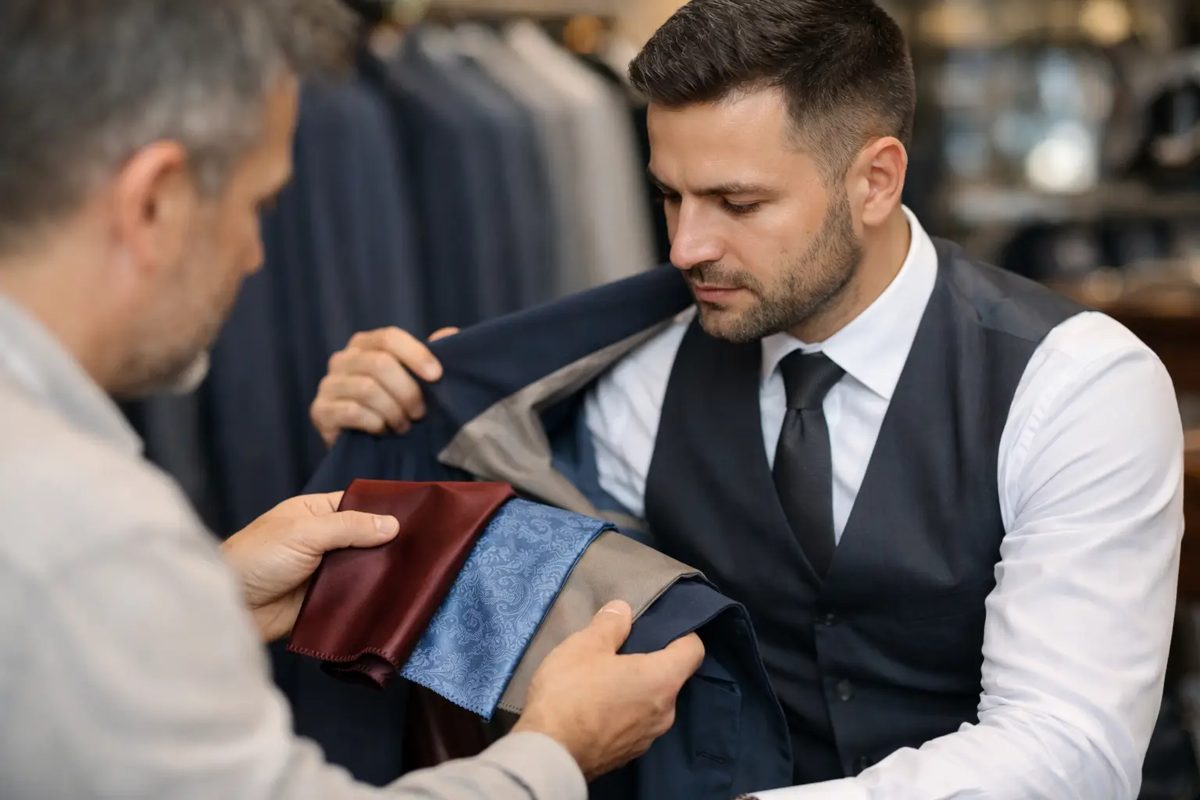
When a suit that looked faultless in the boardroom begins to feel heavy on the shoulders or warm across the back by the second half of the day, the cause often lies not in the outer cloth but in the layer nobody sees. Choosing the right suit lining is not merely a matter of colour and pattern. This choice determines how the suit behaves in movement, how well it suits the season, how the jacket glides over the body and how it will hold its shape over many years.
What does choosing the right suit lining change?
The lining is the inner architecture of the jacket. It reduces friction against the shirt, helps the arms move freely and allows the outer cloth of the jacket to sit more cleanly along the line of the body. In suits made from high-twist wool, cashmere blends and fine worsted cloths in particular, the right lining is a quiet but essential part of the construction.
A quality lining also makes the suit easier to put on and take off. But its principal function is not simply comfort. A lining that is too heavy or does not breathe can overshadow the natural virtues of even the most precious outer cloth. Conversely, a lining that is excessively thin and weak wears through at the points of friction in a short time, increases the strain on the seams and creates an untidy picture inside the jacket.
Fibre content: a choice deeper than the label
The first criterion in choosing a lining is its fibre content. Synthetic linings are usually cheaper, shinier and more slippery. They may seem smooth at first touch, but in warm weather they circulate air poorly, can generate static electricity and over time may feel uncomfortable against the skin. For a suit worn daily at a high tempo, these qualities are not insignificant.
Viscose, and especially cupro-based linings, offer a more natural feel, good air circulation and a refined glide. Cupro is a regenerated cellulose material derived from the fine part of the cotton fibre; it is soft to the touch and behaves calmly in wear. This type of lining adapts better to the breathability of a wool cloth and is often regarded as the considered choice for a professional wardrobe.
Silk lining is attractive for its lustre and softness, but it is not ideal for every suit. It can look exceptional in ceremonial jackets, tuxedos (dinner jackets) and garments that are worn relatively rarely. Nevertheless, for everyday wear one must consider silk's delicacy, its demands in care and its relative weakness against abrasion. Luxury is not always choosing the most expensive option, but choosing the material best suited to the way the garment will be used.
Density and weave define the feel of the jacket
The weight of the lining should be in balance with the weight of the outer cloth. If a thick, dense lining is used beneath a lightweight summer wool, the intended lightness of the suit is lost. The same rule applies to heavier flannel, cashmere or winter wools: an excessively fine lining can make the construction look meagre and create instability inside the jacket.
The surface of the weave also matters. A matt, finely textured lining makes a more restrained impression in an everyday business suit. A glossy jacquard pattern, on the other hand, can reveal personal taste when the jacket is opened. A sense of proportion is essential here. Inside a suit whose exterior is serious, in navy or charcoal grey, a distinctive but not aggressive pattern creates depth; a very bright contrast, however, can undermine the overall seriousness of the suit.
Season and manner of use determine how much lining
Not only the type of lining but how much of it is used in the jacket is a decision. Fully lined, half-lined and unlined constructions do not serve the same purpose. The choice is bound up with a man's daily movement, his working environment, how often he travels and the climate.
A fully lined jacket gives a more structured feel. The interior looks clean, the jacket moves easily over the shirt, and in many formal business suits this construction makes sense. For the autumn and winter season, for a man who works in an air-conditioned office or who wants the jacket to hold its shape more steadily through the day, full lining is the comfortable choice.
In a half-lined jacket, part of the back is left open, while the sleeves and the main structural points are lined. This method offers an advantage especially in the Baku summer, at open-air meetings and for clients who move about frequently. The jacket feels lighter and air circulation at the back increases. That said, half lining is not suitable for every cloth and every silhouette. A very fine cloth, or one that holds its shape with difficulty, may require more internal support.
An unlined jacket is the lightest and most natural option, but it hides nothing of the quality of the tailoring. The clean finishing of the internal seams, the careful binding of the edges and the precision of the cloth selection play a greater role here. This construction can give a beautiful result for summer in high-quality wool, wool-silk-linen blends and for a travel wardrobe. But an unlined jacket may look less formal and may not create an equally stable silhouette on every build.
Colour and pattern: the signature of an unseen detail
The lining is the hidden character of a suit. Among the classic choices, deep blue, tobacco, burgundy or grey tones look natural in a navy suit; for a charcoal grey suit, silver-grey, deep violet or quiet blue shades sit naturally. The aim is not to compete with the outer cloth but to complete its language of colour.
When choosing a patterned lining, the outer cloth of the jacket must be taken into account. Inside a striped or small-checked suit, a large, complex pattern can tire the eye. A plain suit, on the other hand, is more open to a subtle paisley, a micro-geometric or a tonal jacquard lining. A personal monogram, a particular combination of colours or a chosen motif can add an individuality that only the owner will feel, but it is important that this detail does not lose its relevance with time.
Do not compromise on the sleeve lining
Even when the jacket is half-lined or unlined, lining the sleeves is usually essential. It is precisely in this layer, which reduces friction between the shirt sleeve and the outer cloth, that ease of movement is created. If the sleeve lining is poorly chosen, the jacket sleeve can twist, catch on the shirt cuff and cause discomfort in movement.
Because this area is subject to more friction, the durability of the material also matters. Early wear at the elbow, a broken seam or a lining that pulls often creates a false impression of the overall quality of the suit. Together with a precise cut and a correctly built sleeve, a quality sleeve lining noticeably raises the daily performance of the jacket.
How is the lining decision made in bespoke tailoring?
Choosing a lining on the basis of a colour one likes in the swatch book is not enough. The tailor must first establish the purpose of the suit: is this a business suit worn several times a week, or a special commission to be worn at an evening reception? Then the weight, weave and season of the outer cloth and the client's sensitivity to heat are considered.
Build plays a part too. For a man who moves more actively and spends a great deal of time in a car or on an aeroplane, a smooth, breathable and durable lining is more practical. For a client who wants a more formal, structured appearance, a fully lined construction and an inner material of suitable density may answer better. The right decision arises not from a single material but from reading these factors together.
At Atelier Baku 1984, during the personal consultation the lining is assessed separately, after the outer cloth has been chosen. This sequence is not accidental: the lining should be matched not to the visible part of the suit but to its working life and the comfort it gives its owner.
For your next suit, regard the lining not as decoration hidden inside the jacket but as a functional decision felt on every day you wear it. The most successful lining does not draw attention, yet it lets you feel in every movement that the suit belongs to you.