

Why does a suit crease, and what determines it?
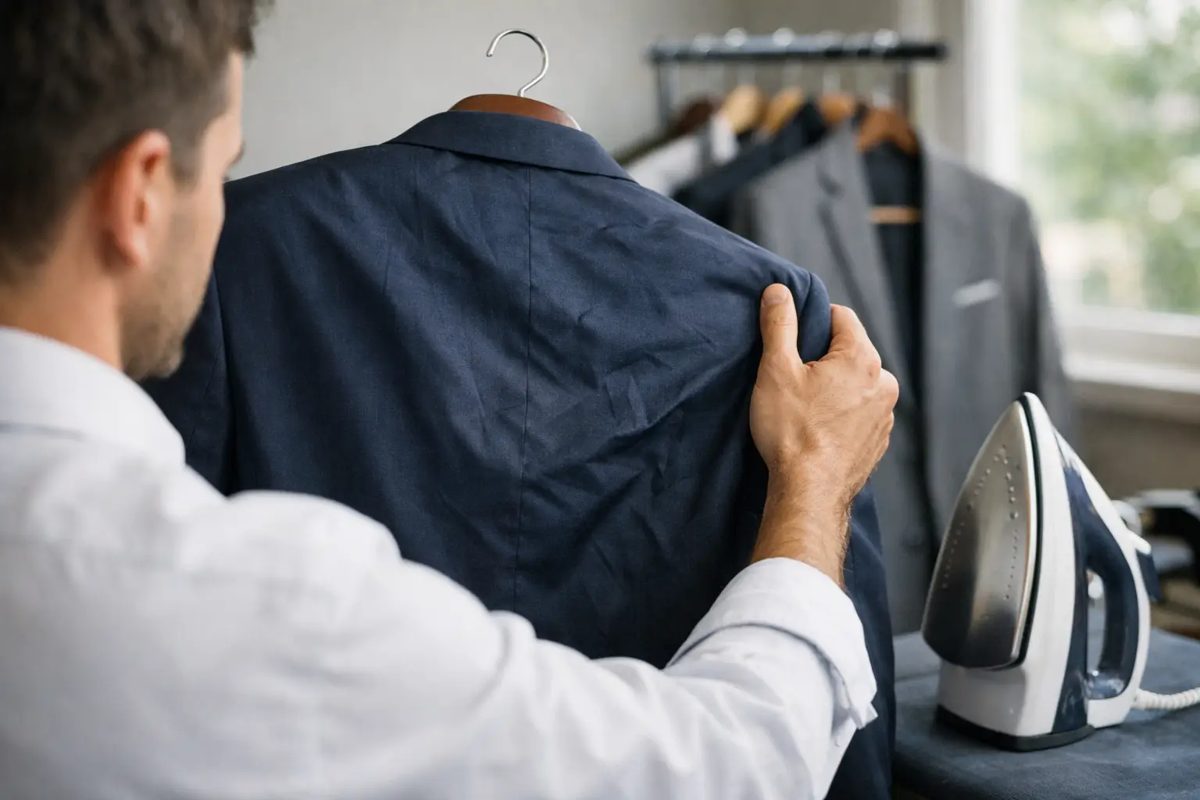
The lines that appear on a jacket sleeve before a meeting, or at the knee of the trousers when stepping out of a car, often change the first impression of a suit's quality. But the answer to the question why does a suit crease does not lie only in whether the cloth is expensive or cheap. The nature of the fibre, the density of the weave, the construction of the suit, its fit on the body and the way its owner wears and keeps it determine the result together.
A light crease should not be regarded as a flaw in a natural cloth. On the contrary, living fibres such as wool, linen and silk respond to movement. The question is not whether a crease forms, but how deep it appears and how far the cloth returns to its original shape after rest. At the end of the day a good suit should look not tired, but full of character.
Why does a suit crease: the memory of the fibre
A cloth's tendency to crease depends first of all on the elastic memory of its fibre. In this respect wool is the principal material of men's tailoring. The natural crimp of the fibre helps it to open out again after compression. That is why a good wool suit, even if it folds while you sit, can soften most of its surface lines by itself after a night on the hanger.
Linen is cooler, dry to the touch and appealing for summer, but its fibres are less elastic. In a linen suit, creasing is a natural characteristic that shows through the day. When chosen correctly, this creates not untidiness but a relaxed, aristocratic summer aesthetic. That said, for formal negotiations, a long programme of events or days when an uninterrupted appearance in front of the cameras is required, a cloth with a high proportion of linen may not be the most practical choice.
Cotton is comfortable too, but in long sitting it tends to leave marks at the knees, the seat and the elbows. Silk can give a suit a delicate lustre and softness, but in its pure form it behaves more sensitively. For this reason, in high-level cloth collections these fibres are most often combined with wool in a considered proportion. The goal is not a glamorous label but behaviour suited to the season and the manner of use.
What do the weight and weave of the cloth change?
Two wool cloths of the same composition may not crease in the same way. The weight of the cloth, the twist of the yarn and the type of weave play the main role here. A very light cloth woven from fine yarn feels exceptionally soft in the hand, but in intensive daily use it can be more delicate. For a long working day, frequent car journeys and back-to-back meetings in particular, choosing by the criterion of fineness alone is not right.
A somewhat more densely woven, medium-weight wool cloth usually holds its shape more steadily. Twill, hopsack or finely textured weaves both show creases less visibly and give the cloth movement. A fold mark on a dark, plain-surfaced cloth can show sooner in the light; a mélange, a micro-texture or a discreet pattern softens that mark.
The Super number, too, is no verdict on quality on its own. A higher Super number means a finer fibre, but for an everyday suit the finest option is not always considered the most appropriate. In a professional wardrobe, durability, the ability to recover and seasonal comfort are as valuable as a brilliant handle. The strength of Loro Piana, Dormeuil, Scabal, Zegna and the other renowned cloth houses lies precisely in how they manage these fine balances.
Sometimes a crease is a problem of fit
Even the finest cloth will produce lines of tension when cut to the wrong measurements. A jacket pulled too tightly at the shoulder, the chest or the back will fold with every movement. When the seat of the trousers is too narrow, the cloth remains under constant strain and the crease deepens quickly.
The opposite is also true. In an excessively loose suit, the surplus cloth is no longer governed by the body. Unnecessary bunching forms at the waist, under the arms, across the back and in the upper part of the trousers. This bunching is most often not a matter to be solved with an iron, but a matter of measurement and cut.
In bespoke tailoring, measurement is not simply the figures for chest and waist. The slope of the shoulders, the shape of the back, posture, the habit of sitting, the natural position of the arm and even the setting in which the suit will be worn are taken into account. For Atelier Baku 1984, too, the choice of cloth and the cut are part of the same conversation: the needs of a client who travels can differ from those of a man who works mainly in the office and at receptions.
Construction and lining affect the look of a crease
The inner structure of the jacket defines how it moves on the body. A fully fused construction may look neat at first glance, but over time, under the effects of heat, movement and dry cleaning, it can lose its natural behaviour. When rippling or stiff folds appear, especially in the chest and lapel area, they are difficult to remove with an ordinary iron.
A jacket built with linen, horsehair and natural canvas elements adapts better to the body over time. This construction demands more skill and proper care, but because it moves together with the cloth, the appearance is more natural. A half-lined or unlined summer jacket feels lighter, but as the inner structure is reduced, the creases in the cloth can also become more visible. This is not a flaw but a conscious choice between comfort and a formal appearance.
Habits that increase creasing through the day
The hardest test for a suit is often not the office but movement. A long car journey, a standing reception, an aeroplane seat or sitting on the phone all day create pressure points in the cloth. Not unbuttoning the front of the jacket when sitting creates unnecessary strain across the stomach and chest. Filling the trouser pockets with a phone, keys and a thick wallet not only spoils the silhouette but causes permanent marks.
Wearing the same suit every day in the same sequence also reduces its capacity to recover. Wool cloth needs to air between wears. A considered rotation of two or three suits both makes your wardrobe more flexible and extends the life of each suit. This is not a call to own many suits; it is the principle of wearing a few well-chosen suits in the right rotation.
The right way to treat a creased suit
The first choice is most often not the iron but steam. Begin by letting the suit rest on a wide-shouldered wooden hanger for 12–24 hours. The humid air of a bathroom can soften light creases somewhat, but direct and excessive moisture is not advisable. For a more controlled result, a hand steamer should be used at a distance from the cloth.
A direct hot iron, particularly on dark wools, can create a shine on the surface and scorch the fibres. When it is necessary, a clean pressing cloth should lie between the iron and the fabric. Parts with a precise shape, such as the collar, the lapel and the trouser crease, call for experienced hands. A mistaken intervention at home sometimes leaves a mark more noticeable than the crease itself.
Nor is dry cleaning a routine to be applied after every wear. Frequent cleaning can weaken the oil balance of natural fibres and the softness of the cloth. If there are no stains, brushing, airing and rest are sufficient in most cases. Professional cleaning at the end of the season and storage in a breathable garment bag is the healthier approach.
A wiser choice for travel
Avoiding creases entirely when travelling is impossible, but managing them is possible. A medium-weight wool cloth with high elastic recovery and a micro-textured surface is among the most reliable choices. When folding a suit into a suitcase, instead of creating a hard fold, turning the jacket inside out and nesting the shoulders softly into one another, and folding the trousers in a wide fold, gives a better result.
On arrival at the hotel, the suit should be taken out and put on a hanger at once. A light steaming a few hours before the event allows the cloth to gather itself. For travel days, rather than choosing a very fine cloth suited only to special ceremonies, choosing a cloth that answers your working regime is the more far-sighted decision.
Not every line on a suit is a flaw. The trace of movement in a natural fibre is a sign of life in a well-fitting, well-chosen suit. What matters is that the cloth returns to its shape, that the cut does not constrict the body and that habits of care preserve this quality. When choosing your next suit, think beyond the first impression in the mirror to how it will look in the evening hours.