

How and When Should Suit Colours Be Chosen?
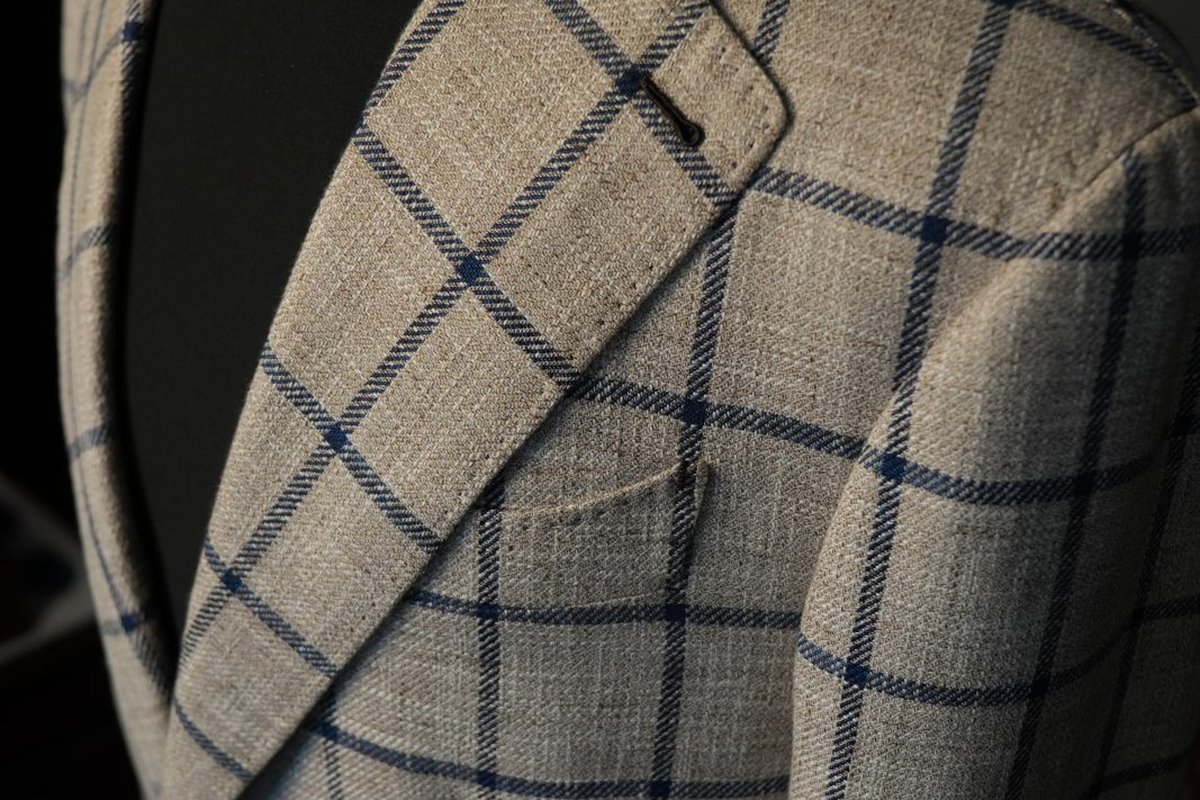
The navy suit a director chooses for a first business meeting and the suit of the same colour he wears to an evening reception may look formally similar. Yet the surface of the cloth, the depth of the tone and the relationship it strikes with shirt and tie change the impression entirely. Suit colours are not merely a wardrobe question. They express a man's attitude to the occasion, his professional standing and the consistency of his taste.
In bespoke tailoring, the choice of colour is never considered apart from the taking of measurements. A correct cut shows the tone of the cloth clearly, and the right cloth determines how the suit will read in daylight, in the office and in an evening room. A decision about colour therefore belongs not only in front of the mirror, but in the context of your way of life, your working diary and the wardrobe you already own.
Suit colours and the first signal of trust
Three colours hold a particular place in the classic men's wardrobe: navy, grey and black. This does not mean other colours are out of place. It means simply that these three form a stable foundation suited to different degrees of formality, to the seasons and to professional settings.
A navy suit is very often the most intelligent first choice. It is not as severe as black, and it does not read as casually as light blue. It looks serious at a morning meeting, at ease over lunch and sufficiently considered at an evening event. In Baku's business circles in particular, navy produces a disciplined, dependable appearance without any display of status.
The grey suit is far more a question of tone. Mid-grey is a calm and versatile choice for the everyday working wardrobe. Charcoal reads as more formal and more mature, and finds its place in negotiations at the highest level. Light grey has an elegance of its own in spring and summer, but its use depends more on circumstance: it comes into its own in strong light, at a daytime occasion and in a room with a more relaxed dress code.
The standing of the black suit is beyond question, though its role is often misunderstood. Black is intended, at its best, for evening ceremonies, formal receptions, funerals and strict protocol. Wearing a black suit to the office every day can look less like elegance than excessive formality. As the first and only suit of a business wardrobe, navy or charcoal is the more considered choice.
Why the depth of navy makes the difference
"Navy" is not a single colour. A navy as deep as a night sky, a livelier royal blue, an ink shade or a greyish blue each carry an entirely different character. These shades should be judged together with the composition and the handle of the cloth.
A smooth-faced navy suit in fine worsted wool, for example, looks serious and clean. The same colour in flannel gives a softer, more seasonal, more textured impression. In the high-quality wools of mills such as Loro Piana and Zegna, the depth of the colour shows without any sheen on the surface. That quality is felt in the impression the suit makes in a real room, not in photographs.
The advantage of a navy suit also lies in what accompanies it. A white shirt gives the most formal contrast. A pale blue shirt makes a gentler transition into the everyday working register. Burgundy, dark green or brown ties build a quiet harmony with navy. The principle here is simple: there should be no competition between the colours, but graded depth.
Balance of tone and texture in a grey suit
Grey is among the most accommodating colours in tailoring. In both light and dark tones it makes the choice of shirt and accessories easier. Even so, the success of a grey suit depends on reading the tone correctly.
Charcoal, particularly with a fine pinstripe or a very faint check, looks authoritative in a corporate setting. But lustrous threads and excessively distinct stripes can make a suit look like a fashion item that will date quickly. The best examples read as quiet from a distance and reveal the quality and the handle of the cloth close to.
A mid-grey suit lends itself to wider use. It sits easily with dark brown shoes, a burgundy tie and a pale blue shirt. This colour is practical above all for the man who travels often and wears one suit through several different meetings in a day. In very light greys, however, marks, creasing and the traces of daily wear show more quickly. For anyone with a demanding schedule, how the cloth behaves under creasing therefore matters as much as its colour.
Grey flannel takes on a particular meaning in autumn and winter. Its matt surface softens the light, gives depth to the silhouette and creates a sense of warmth without looking bulky. For summer, lighter-weight, breathable wools or wool-silk blends may be more suitable. Here, suitability to the season is not only a matter of comfort but of visual restraint.
The proper place of the black suit
There is no need to give up the black suit. It simply has to be worn for its purpose. Evening dinners, formal award ceremonies and occasions of high protocol are the settings in which black shows its strength. In high-quality black wool especially, a correct shoulder construction and a clean trouser line complete the effect.
The difficulty with black is that any weakness in the quality of the cloth shows sooner in this colour. Synthetic sheen, dust on the surface, a poor pressing mark and mismatched shades of black draw the eye at once. The cloth of a black suit should therefore be matt, densely woven and clean-faced. Black shoes and simple, high-quality accessories are its most natural complement.
For a wedding, the hour of the occasion and the dress code are decisive. For a daytime wedding, navy, mid-grey or a chosen earth tone may look more natural. At a formal evening ceremony a black suit is right, and a tuxedo (dinner jacket) more so if the dress code calls for it. Treating a suit and a tuxedo as interchangeable is a mistake: the lapel construction, the surface of the cloth and the shirt they require are all different.
Season, skin tone and the light of the room
The choice of colour is bound up with a man's skin tone, though this rule should never be turned into a rigid scheme. On a fair-skinned man a very washed-out grey can reduce the contrast; a deeper blue or charcoal reads more clearly. On a darker-skinned man, mid and light greys, rich blues, tobacco and olive shades can give a very refined result. What matters is that the colour brings life to the face rather than fatigue.
The light of the room should be taken into account as well. A colour you admire in the atelier can look lighter in daylight and deeper under warm artificial light. For this reason it is not enough to look at a bunch of cloth from one angle only. Seeing the cloth by a window, in different light where possible, and judging it alongside the shirt colours you have in mind, is the sounder decision.
The heat of a Baku summer also calls for practical choices. Very dark cloth in a heavy weight can be uncomfortable through the day. Choosing a lighter tone is not always the only answer either. A high-twist, lightweight wool can make even a navy or charcoal suit more suitable in warm weather. Separating colour from the weight of the cloth is not the right approach.
Thinking of colour as part of the whole wardrobe
When choosing a new suit, the first question is not "is this colour handsome?" but "what will this colour work with in my wardrobe?" If you own white and pale blue shirts, brown and black shoes and a few good ties, navy and mid-grey will give you the widest range of combinations. Later you can move on to tones with more character, such as olive, tobacco, chocolate brown or deep burgundy.
The choice of a patterned suit follows the same logic. For a first suit, a plain colour or a micro-texture visible only at close range lasts longer. For a second and third, a fine stripe, Prince of Wales, herringbone or a light check can add depth to the wardrobe. As the pattern grows larger and the contrast stronger, the range of use of the suit narrows.
This is precisely where the advantage of a bespoke commission shows itself: colour, cloth, buttons, lining and silhouette are not separate decisions. At Atelier Baku 1984, during a personal consultation, all of these elements are considered together with the client's working rhythm, his engagements and the wardrobe he already has. The result is built not to make a seasonal impression, but to be worn with confidence for years.
The best choice of colour is the one that draws no attention to the suit itself and shows its owner's bearing more clearly. See the cloth in daylight, think of the room in which you will wear it, and make the decision by the wardrobe of the years ahead rather than by today's wish alone.