

Choosing cloth for a suit: the precise criteria
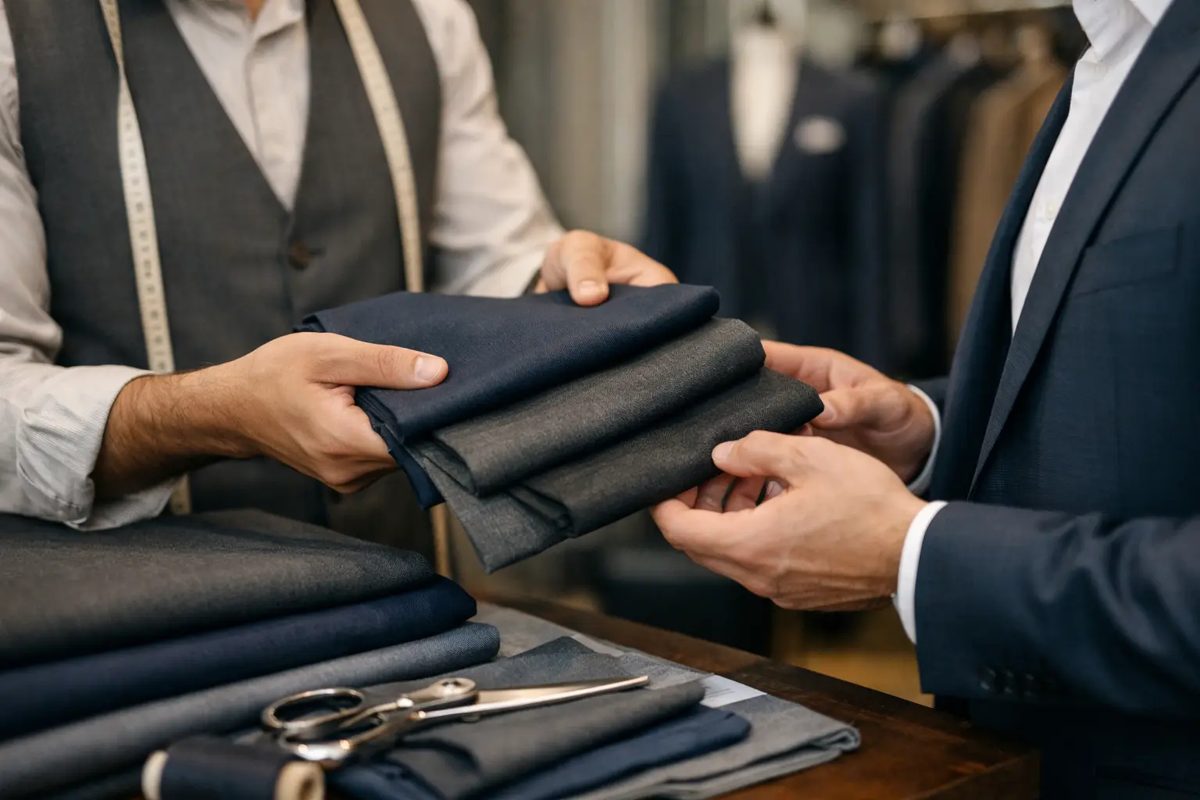
At first glance, a suit is remembered for its colour and cut. But the essential factor that makes it a pleasure to wear for years, comfortable in movement and convincing at close range is the cloth. Choosing cloth for a suit is not simply picking the blue or grey tone you like. It is a considered decision concerning the origin of the fibre, the twist of the yarn, the density of the weave, the weight of the cloth, your working schedule and the environment in which the suit will be worn.
In bespoke tailoring, the cloth is chosen to suit the client's way of life. For an executive who spends most of the day in meetings, durability and shape retention matter. For a ceremony held outdoors in the summer months, a construction that looks equally elegant but breathes more freely is required. The right choice determines not only how the suit looks but the comfort it gives its owner.
Where does choosing cloth for a suit begin?
The first question should not be "Which colour would you like?" The more correct question is this: where, how often and in which season will the suit be worn? Many men look for a universal choice in their first bespoke suit. In that case, a medium-weight wool cloth in navy or charcoal grey is the most rational beginning. It can adapt to a business meeting, a formal dinner and a journey alike.
But universality does not always mean the same cloth. Given the long summer season in the Baku climate, a dense, heavy winter wool can be tiring for everyday use. On the other hand, an excessively light cloth may lose its shape more quickly in an air-conditioned office and in a working routine of frequent sitting and standing. The value of a personal consultation lies precisely in taking these subtle differences into account.
Touching the cloth is important, but softness alone is not a measure of quality. Some cloths seem as soft as silk at first touch, yet prove more delicate in daily wear. Others give a drier, somewhat firmer handle, and in return hold a crease and the line of the trousers better. True quality is seen not in the cloth book but in the cloth's relationship with its intended use.
Fibre content: the superiority of wool and the role of blends
The principal material for a classic men's suit is fine sheep's wool. Wool has a natural elasticity: during rest, the cloth releases some of the creases formed through the day, allows movement without constricting the body too much and, when chosen in the right weight for the season, balances temperature. These qualities make wool the essential fibre of four-season suits.
The quality of wool is not measured by the fineness of the fibre alone. Indicators such as Super 110, Super 130 or Super 150 tell you about the delicacy of the fibre, but a higher number does not automatically mean a better choice. A quality cloth at the Super 110 and 120 level is often the more sensible option for an everyday suit: durable, comfortable and relatively easy to care for. Super 150 and finer wools, on the other hand, can be the superior choice for special occasions, a lighter construction and careful use.
A cashmere blend gives a cloth warmth and softness. In an autumn-winter suit, a small proportion of cashmere can create a richer handle. But as the proportion of cashmere rises, the cloth can become more delicate and wear quickly in the areas of friction. For this reason, a cloth containing cashmere is more appropriate not for a client who wears the same suit every day, but for a more select suit worn in rotation.
Silk brings lustre and softness, while linen brings the dry texture and airiness characteristic of summer. The creasing of linen is not a flaw but its natural behaviour. A pure linen suit is perfect for a Mediterranean aesthetic and relaxed social occasions, but it may not deliver the ever-neat appearance demanded by strict corporate protocol. A wool-linen-silk blend, however, creates an elegant compromise between these differing qualities: the wool controls the shape, the linen breathes and the silk adds depth to the surface.
Weight and weave change the behaviour of the suit
The weight of a cloth is usually measured in grams per metre. The range of roughly 240–270 grams is considered a flexible choice for four seasons or a warm climate. The 280–320 gram range gives a fuller drape, a sharper trouser crease and comfort in cool weather. Heavier cloths find their place particularly in the winter season, in suits where structure and depth are desired.
The virtue of a light cloth is comfort, but it has its own discipline. A very fine, open-weave summer cloth may move beautifully on the body, yet it may not be ideal for carrying a phone in the pocket, for long journeys and for an intensive office day. A heavy cloth gives a better drape, that is, a better fall on the body, but in summer it can create unnecessary heat. The aim is not to find the lightest or the heaviest cloth possible, but to choose the weight that suits the rhythm of wear.
The weave is equally important. A smooth-surfaced worsted wool looks more formal, clean and business-oriented. Open-weave cloths such as fresco are distinguished by their breathability and resistance to creasing, and are especially sensible in hot weather and when travelling. Flannel, with its soft, matt surface, gives character to the autumn-winter season. A hopsack weave gives a good result for blazers and separates with a more textured, somewhat more relaxed appearance.
Colour, pattern and frequency of use
A navy suit is the most reliable beginning in most personal wardrobes. It is not as severe as black, and though it is as neutral as grey, it looks more alive and deeper. Charcoal grey is a particularly strong choice for a serious business environment, formal negotiations and meetings of a diplomatic character. Mid-grey is flexible for daytime use, while light grey is selective about season and setting.
In pattern, scale is the principle. A fine pinstripe that looks plain from a distance, or a very fine check weave, gives the suit depth without diverting attention from its owner. Larger checks show personal taste more clearly and are valuable as a second or third suit. In a first or principal business suit, however, the cloth should create a sense of quality without putting itself on display.
The behaviour of colour in the light must also be considered. A navy that looks dark in the cloth book can take on a livelier blue cast in sunlight. A grey cloth, depending on its warm or cool undertone, changes the choice of shirt, tie and shoes. For this reason, the choice of cloth is not completed by looking at a small sample alone: it is more correct to assess it in daylight and, where possible, together with the construction proposed for the jacket.
Cloth and construction are inseparable
The same cloth makes an entirely different impression in a different construction. A light summer wool can look natural and relaxed in a half-lined, soft-shouldered jacket. A denser, heavier wool creates a strong, balanced silhouette with a defined shoulder and full canvas construction. Choosing the cloth separately from the cut is therefore the wrong approach.
Build also influences the decision. On a more athletic build, a cloth with a soft drape shows movement naturally. On a slim or tall silhouette, a cloth carrying a certain degree of structure can give the line of the jacket a fuller look. The tailor's task is to make the character of the cloth work not against the body but together with it.
At Atelier Baku 1984, working with the collections of cloth houses such as Loro Piana, Dormeuil, Piacenza 1733, Drago, Scabal, Reda and Zegna does not limit the choice to a name. These collections offer a wide technical range for different climates, weights, weaves and scenarios of use. What matters is not the label but that the particular cloth plays the right role in the life of the particular client.
When choosing cloth for a suit, the most reliable criterion is not a dazzling effect in the shop window but a rightness still felt several seasons later. If the cloth sits comfortably on your body, keeps its shape at the end of the working day and allows you to look well-dressed without proving anything to anyone, the choice is the right one.