

What Sets Luxury Men's Tailoring Apart?
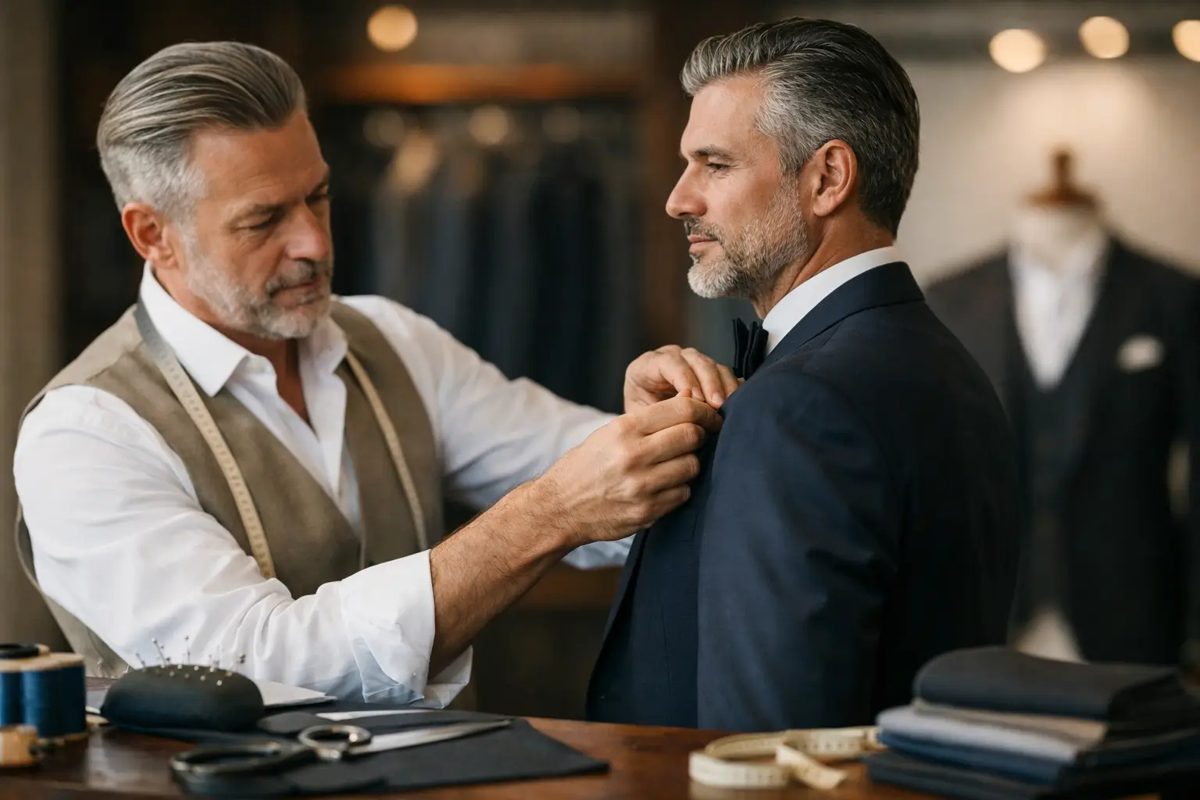
Even when the shoulders of a ready-to-wear suit look right, a gap at the collar, excess cloth at the waist or strain in movement immediately betray its true quality. Luxury men's tailoring begins precisely with these invisible yet perceptible differences. The aim here is not simply to make an expensive suit, but to create clothing suited to a man's build, his daily rhythm and the position he represents.
Good tailoring does not show off at first glance. It is seen in the naturalness of the shoulder line, in the calm way the collar sits over the shirt, in trousers that hold their shape in movement. This is the value of discreet luxury: the garment does not speak before its owner, yet it creates the right impression of him.
What does luxury men's tailoring change?
In bespoke tailoring, a measurement is not only a set of chest, waist and height figures. The forward or backward slope of the shoulders, the structure of the neck, the length of the arms, posture, one leg standing differently from the other, and even whether the client's work is mostly sedentary or active all influence the cut. Ready-to-wear tries to resolve all these differences for an average, statistical body. The tailor takes them into account for one specific person.
This approach changes not only the look of the suit but also its comfort. A properly made jacket does not weigh on the shoulders, does not strain across the chest when buttoned and does not ride up at the collar when you sit. The trousers stay in place without pinching at the waist, and the width of the leg is balanced with the shoe and the overall silhouette. These subtleties matter most at long meetings, on flights, at official receptions and at weddings, where events last for hours.
In the luxury category, the main criterion is not a logo or a flashy detail. Value is formed in the selection of the material, the precision of the construction, the application of handwork where it is needed and the correct reading of the client's needs. In the end, the worth of a suit lies not only in the cloth but in how it works for you.
The real difference between bespoke and made-to-measure
Although these two terms are often used interchangeably, their approaches differ. Made-to-measure, that is clothing adjusted to individual measurements, is produced by altering an existing pattern according to the client's measurements and choices. The length of the jacket, the fit of the waist, the sleeve measurement, the choice of buttons, the shape of the lapel and a number of constructional details can be personalised. For a man whose time is limited but who expects greater precision than ready-to-wear standards, this is a very considered choice.
Bespoke means the pattern is created from scratch for one specific body. This process calls for more measurements, more fittings and deeper constructional intervention. For a client with very non-standard body proportions, a particular posture or the intention to build a wardrobe that will be kept for many years, bespoke is usually the more logical choice.
The answer to "which is better" is not always the same. Made-to-measure, in the right atelier and with the right measurements, can give a very high result. Bespoke opens wider possibilities, but requires time and attention to the process. The choice depends on the purpose of the suit, how often one commissions and one's build.
Taking measurements is only the beginning
During a professional consultation, the tailor does not rely on the tape measure alone. He observes how the client stands, his habit of buttoning the jacket, which pocket he uses most for a telephone or business cards, whether he drives a car. Sometimes a person's dominant shoulder, a more upright neck or broad thighs change every decision about the construction.
This is also why the fitting stage is essential. A measurement that looks correct on paper may behave differently on the body. Here the tailor checks the balance: the front and back of the jacket, the fall of the sleeve, the closeness of the collar to the neck, the break of the trousers and the waistline must all work in harmony with one another.
Cloth quality is more than appearance
The names of the great cloth houses are not merely marks of prestige. The value of makers such as Loro Piana, Dormeuil, Piacenza 1733, Drago, Scabal, Reda and Zegna is seen in the selection of fibre, the processing of the yarn, the density of the weave, the depth of colour and the way the cloth behaves over time. A good wool cloth may feel soft to the touch, but its main advantage is that it holds its shape, breathes and looks calm and deep under light.
Nor should the cloth's "Super" number decide on its own. A finer fibre sometimes gives a more refined feel, but it is not always the most practical option for intensive daily wear. A very fine wool, for instance, may be a beautiful choice for a summer evening, but for a man who travels frequently and wears a suit several times a week, a mid-weight cloth with good elasticity and recovery is more useful.
Baku's seasonal rhythm also shapes the choice. In the hot months, open-weave wool, wool-silk blends and lightweight materials give comfort. In the cool season, flannel, a more densely woven worsted wool and textured cloth add depth to a suit. The choice of colour should not be considered apart from the rest of the wardrobe. Dark blue, charcoal and mid-grey are well-founded choices for a first commission; tobacco, olive, dark brown and subtly patterned cloths create character at a later stage.
Construction determines how a suit behaves
The inner structure of a jacket is rarely seen, yet it is precisely this part that determines how the jacket sits on the body. A fully fused construction may look neat at first, but over time it can remain limited in terms of natural movement and shape. A half-canvassed or fully canvassed construction gives the chest of the jacket a more living form and creates a natural transition between cloth and body.
This does not mean every suit must necessarily have the heaviest and most complex construction. Climate, frequency of wear and personal taste must be considered. For summer, a light, partially lined jacket can be more comfortable. A more formal winter suit may look more distinguished with a structured shoulder and a fully shaped chest. In luxury tailoring, the right choice is not the maximum of detail but the right detail for the right purpose.
The shape of the lapel, its width and the position of the buttons also change the silhouette. A tall man may look at ease with a wide lapel, whereas on a slighter build excessive width can upset the proportions. The classic two-button jacket is a reliable choice for most business and formal settings. A three-piece suit looks more formal and expressive, but for everyday use it may not suit every man's way of life.
A personal wardrobe does not end with one suit
The most successful personal wardrobe is not the sum of random commissions. It consists of garments that speak to one another. The first suit should be able to work with different shirts, ties and shoes at daily business meetings, at dinner and at a formal invitation. Subsequent commissions should be built on this foundation.
In a shirt, the collar shape, the cuff, the density of the cloth and the sleeve length are as important as in the jacket. A good shirt rises correctly from the jacket collar, and the cuff shows in measured proportion beneath the sleeve. A seven-fold tie made of Como silk is distinguished not by extra lining but by the natural body of the folded silk; worn with the right knot, it gives the neckline a quiet yet noticeable depth.
In an atelier founded on a personal approach, such as Atelier Baku 1984, this continuity makes every new commission more precise. As the tailor comes to know the earlier measurements, the favoured silhouette and the habits of wear, the process of choosing becomes quicker and the result takes on a more personal character.
Luxury men's tailoring is not a quick decision. It calls for several meetings, contact with the cloth, careful fittings before the mirror and time. In return, the garment obtained is made not for a single event but for the moments when its owner feels most truly himself. Choosing, for the first commission, not the most striking cloth but the role your life demands most often is the soundest beginning for a long-lived wardrobe.