

What is the difference between made-to-measure and bespoke?
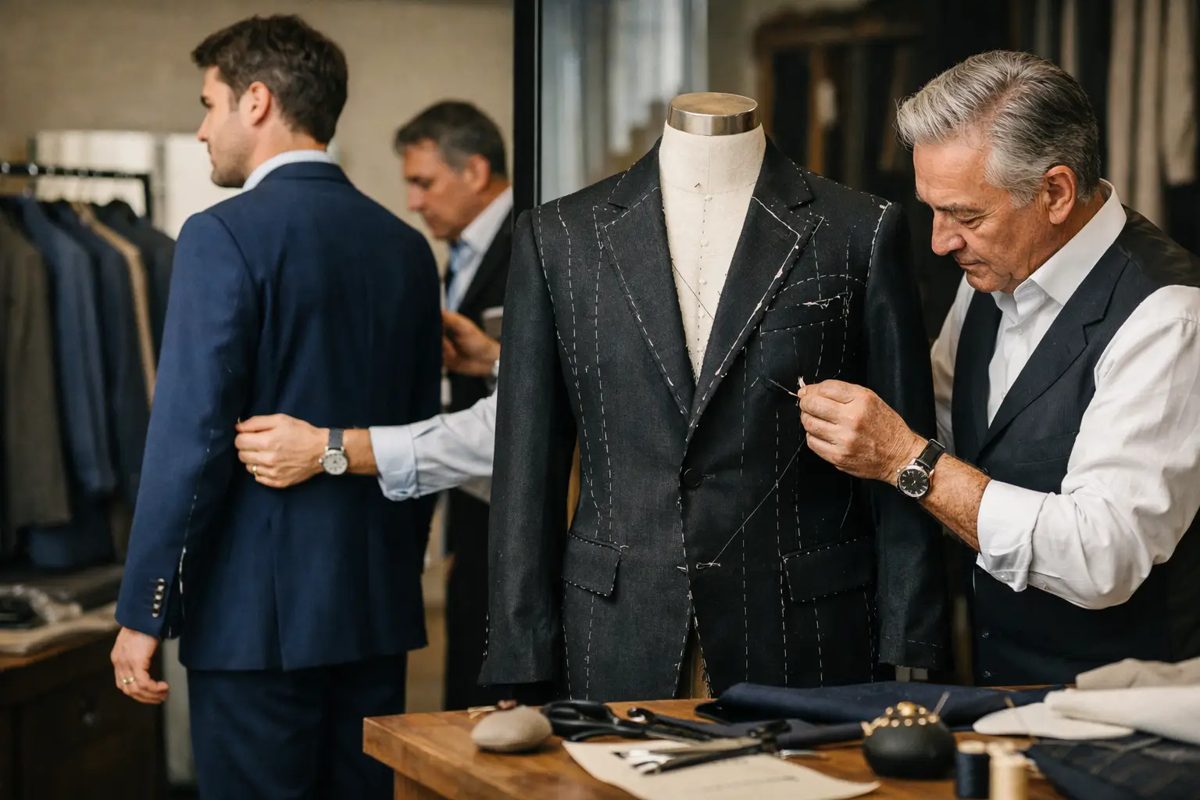
A ready-to-wear suit may look right at the shoulders, yet pull across the chest in movement or leave the waist too loose. This is not merely a question of size; it is a question of reading the body's proportions. The difference between made-to-measure and bespoke begins precisely here: both services promise a personal appearance, but they reach that result by different tailoring methods.
For a man who takes a conscious approach to the classic wardrobe, it is useful to know where the boundary between these two concepts lies. The right choice determines not only how the suit will look on the first day, but how well it will remain suited to his working schedule, his social environment and years of wear.
The difference between made-to-measure and bespoke: the basic principle
Made-to-measure, that is clothing adapted to individual measurements, is built on an existing base pattern. The tailor takes the body measurements, takes posture and proportions into account, and then alters the pattern of the chosen model according to those figures. The length of the jacket, the sleeve length, the waistline, the fit of the trousers and the other principal parts are adjusted to the client's measurements.
Bespoke means a pattern created from scratch. The tailor assesses not only the chest, waist and sleeve measurements but the direction of the shoulders, the carriage of the neck, the line of the back, the difference between one shoulder and the other, habits of movement and the overall balance of the body. On the basis of these observations, a paper pattern is drafted for that client alone. On subsequent commissions this pattern is kept and refined.
The difference lies in details that sometimes look small but are decisive on the suit. A forward-sloping shoulder, a powerful chest or an asymmetric posture, for instance, may require a serious departure from the standard pattern. Made-to-measure successfully compensates for some of these cases. Bespoke gives far wider scope to build the construction according to the body's own logic.
How does the pattern change the look of the suit?
The fit of a good suit is not measured simply by whether the button fastens. The precise position of the shoulder seam, the way the collar lies against the neck, the chest sitting calmly over the body and the fit of the trousers together create the silhouette. If one of these elements is weak, even the most precious cloth cannot show its full potential.
In a made-to-measure commission, the starting point is a model that has already been proven. This is a wise choice for a client with regular proportions, limited time and no wish to depart from a classic cut. Thanks to correct measuring and professional corrections, the result differs noticeably from ready-to-wear.
In a bespoke commission, the model is not adapted to the body; it is built for it. The balance of the jacket, the height of the armhole, the width of the lapel, the shape of the waist and the flare of the skirt are not separate from one another but parts of a single construction. This method is particularly valuable for an athletic build, very broad or narrow shoulders, great height, a short torso or other proportions that standard sizes struggle to answer.
Why does the fitting stage make a difference?
In bespoke tailoring, the fitting garment is a central stage. While the cloth is not yet fully worked, the tailor sees how the suit behaves on the body: is there tension at the front, does excess cloth gather at the back, does the collar stand away, is the arm free to move. The corrections are transferred to the pattern and the making moves to the next stage.
A fitting and final adjustment are also possible in the made-to-measure process, but the scope of the changes is limited by what the base pattern allows. This does not weaken the service. It simply defines the character of the result. The first option offers precise adaptation; the second offers a fully individual construction.
The choice of cloth is equally important in both services
It would be wrong to attribute the advantage of a bespoke suit to the pattern alone. The weight, weave, elasticity, fibre composition and density of the cloth affect both the look and the behaviour of the suit. A light Super 130s wool can be a fine and elegant choice for long working days in Baku, but for a man who travels often and wants a more durable wardrobe, a robust, mid-weight wool is more sensible.
In the collections of cloth houses such as Loro Piana, Dormeuil, Piacenza 1733, Drago, Scabal, Reda and Zegna, the choice is not only a matter of colour. A dark blue twill is the anchor of the everyday business wardrobe. Charcoal grey creates a restrained impression at formal meetings. Open-textured wool, cashmere blends or seasonal woollens offer more personal, yet still classic, solutions.
In a made-to-measure commission, the choice of cloth can raise the level of the suit considerably. In a bespoke commission, a closer relationship is built between cloth and construction. A softly draping Italian cloth, for example, can work beautifully in a lighter construction with a more natural shoulder. A drier, more formal wool of British character suits a clean-lined, structured silhouette.
Construction, comfort and longevity
The unseen parts inside a suit determine its everyday comfort. A fused construction is practical in rapid production, but over time it can impose limits on shape and breathability. Half-canvas and full-canvas constructions allow the chest to conform to the body, let the cloth fall more naturally and give the suit the chance to gain character over the years.
On this subject, bespoke is not automatically the right decision in every case. If the purpose of the wardrobe is to create a few dependable business suits, keep the lead time reasonable and obtain a classic silhouette, good made-to-measure gives a very strong result. The essential conditions are that the measurements are taken with care, the choice of cloth matches the scenario of use and the final corrections are not neglected.
Bespoke, on the other hand, is a meaningful investment for someone who wants deeper personalisation, wears a suit regularly and already knows which details work for his body. This service is not a novelty for a single season. A quality suit that is properly stored and worn in rotation keeps its place in the wardrobe for many years.
Which choice suits you?
It is better to make the decision not as a statement of status but as a precise reading of need. For a client commissioning his first personal suit, with classic proportions and a specific date to be ready for, made-to-measure is very often the ideal beginning. It moves away from the compromises of ready-to-wear and allows a personal fit, a selected cloth and individual taste.
If your build differs seriously from standard patterns, if discomfort in clothing recurs, or if you have a particular silhouette in mind, bespoke is the better-founded choice. At a diplomatic reception, a wedding, an important presentation or in the daily appearance of a man in a leading position, a suit that looks calm, precise and natural says a great deal. The aim here is not to draw attention to the suit, but to make the man himself look more assured.
At Atelier Baku 1984, this choice begins with a personal consultation. In the tailoring process, not only the client's measurements are considered, but also the settings in which he will wear the suit, the colours he prefers and the gaps he wishes to fill in his wardrobe. Sometimes the most correct decision is not a bespoke commission but a well-built made-to-measure suit in a superior cloth.
The right questions to ask before commissioning
Before going to meet the tailor, it is useful to clarify the purpose of the suit: how many days a week will you wear it, and will you use it mostly in the office, on journeys or at events? The season, your colour palette and the shoes you already own also influence the choice of cloth and model.
Consider, too, how classic you want the cut to be. A dark blue two-button suit, independent of fashion, is usually the most-worn choice. But a well-proportioned three-piece, a double-breasted jacket or a tuxedo (dinner jacket) for a special ceremony should be chosen to suit not only your body but your way of life.
The best commission is not the one that tries to show itself off in the mirror at once, but the one comfortable enough to make you forget it is there during the day. Asking the right questions about measurements, cloth and construction is the first step towards that quiet, flawless result.