

How to choose a mandarin jacket
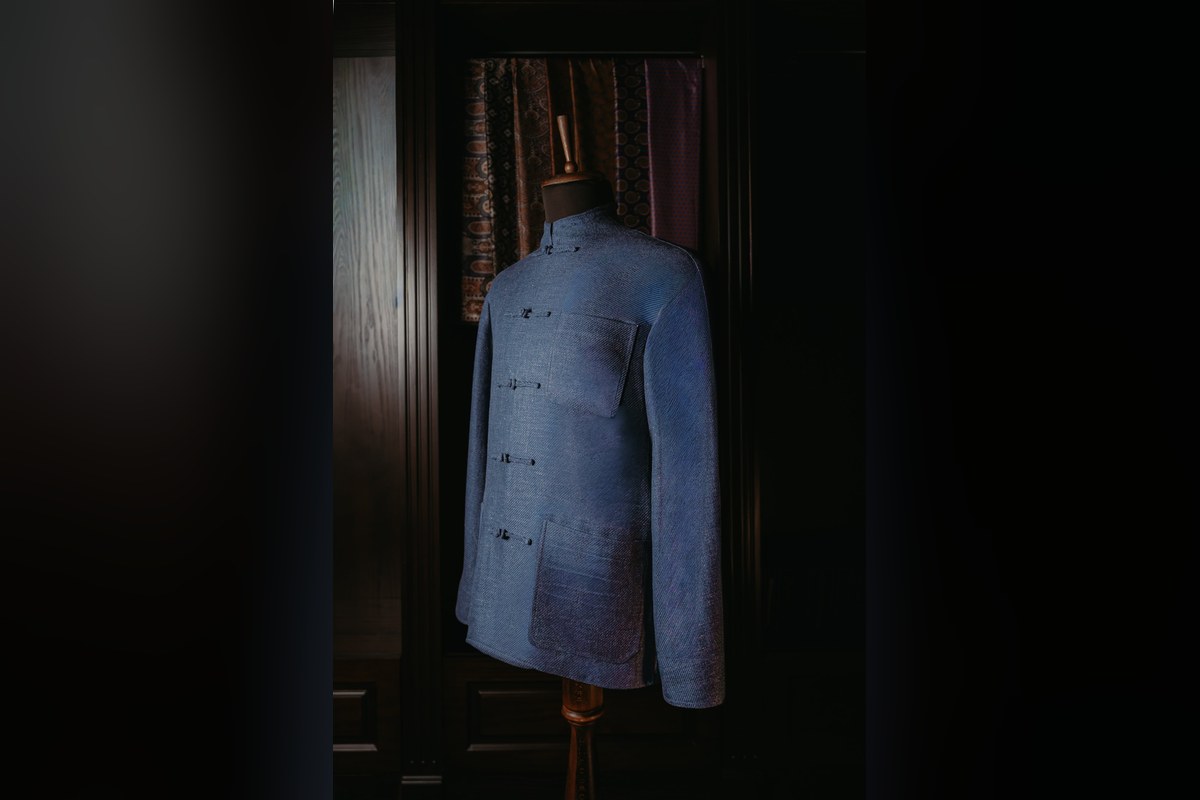
Some models enter a wardrobe for a single detail. In the mandarin jacket there are two: a stand collar that wraps the neck in a short band, and fabric frog fastenings in place of buttons.
These two elements give the jacket an instantly recognisable character. Yet made properly it looks as neat as a suit and as easy as a shirt, at home at a celebratory dinner as much as on a Saturday walk.
What a mandarin collar is
The mandarin collar comes from traditional Chinese dress: it does not roll, it wraps the neck in a straight, low band, with a small opening at the front. In European tailoring it is often also known as the Nehru or stand collar.
The height of the collar sets the tone of the whole model. A low collar looks quieter and more casual; a slightly higher one gives a more formal, more compact line. The measure is chosen by the length of the neck and the shape of the face.
The collar must not grip the neck: there should be about a finger of space between collar and neck, and when the head turns the collar should not lift at the back.
Fabric frog fastenings
The detail that sets the mandarin jacket apart most is its fastenings. Instead of a button and buttonhole, a cord of rolled cloth is tied into a knot, with a loop on the opposite side. The knot passes through the loop and the jacket is closed.
When the fastenings are made from the jacket cloth itself, the garment looks whole: the detail is in plain view but does not create a separate patch of colour. The thickness of the cord is matched to the weight of the cloth so that the knot looks neither too large nor lost.
The fastenings are handwork, and their even placement decides the look of the whole front. Every knot must sit at the same height, the same spacing and the same angle, otherwise the straight front line breaks at once.
Cloth and season
Depending on the cloth, a mandarin jacket can belong to quite different seasons. For summer and early autumn, wool, silk and linen blends work well: they are light, they breathe, and in a herringbone or twill weave they give a lively texture.
Summer Tweed from the Cerruti mill is an example of such a blend: a weave with the look of tweed but the weight of a summer cloth, which opens up especially well in blue and enriches the simple line of the mandarin model.
For winter the same model is made in cashmere or soft flannel. The jacket then becomes almost a light outer layer and can be worn over a sweater.
Construction
With no lapel, the fit at the shoulder and neck is especially visible in a mandarin jacket. A soft shoulder and minimal canvas keep the easy character of the model, but the back width and sleeve head must be built precisely.
Patch pockets and a single button on the cuff continue its semi-casual spirit. The lining is usually light, or kept only through the shoulders.
What to wear it with
Fine knitwear, a shirt with a simple collar or a roll-neck all suit it well. A tie is not worn with a mandarin jacket: the stand collar takes its place.
For trousers choose wool, flannel or dark denim, and for shoes loafers, Chelsea boots or soft derbies. At Atelier Baku 1984 the mandarin jacket is made to individual measurements; the lead time is up to four weeks.