

The right measure for adjusting jacket sleeve length
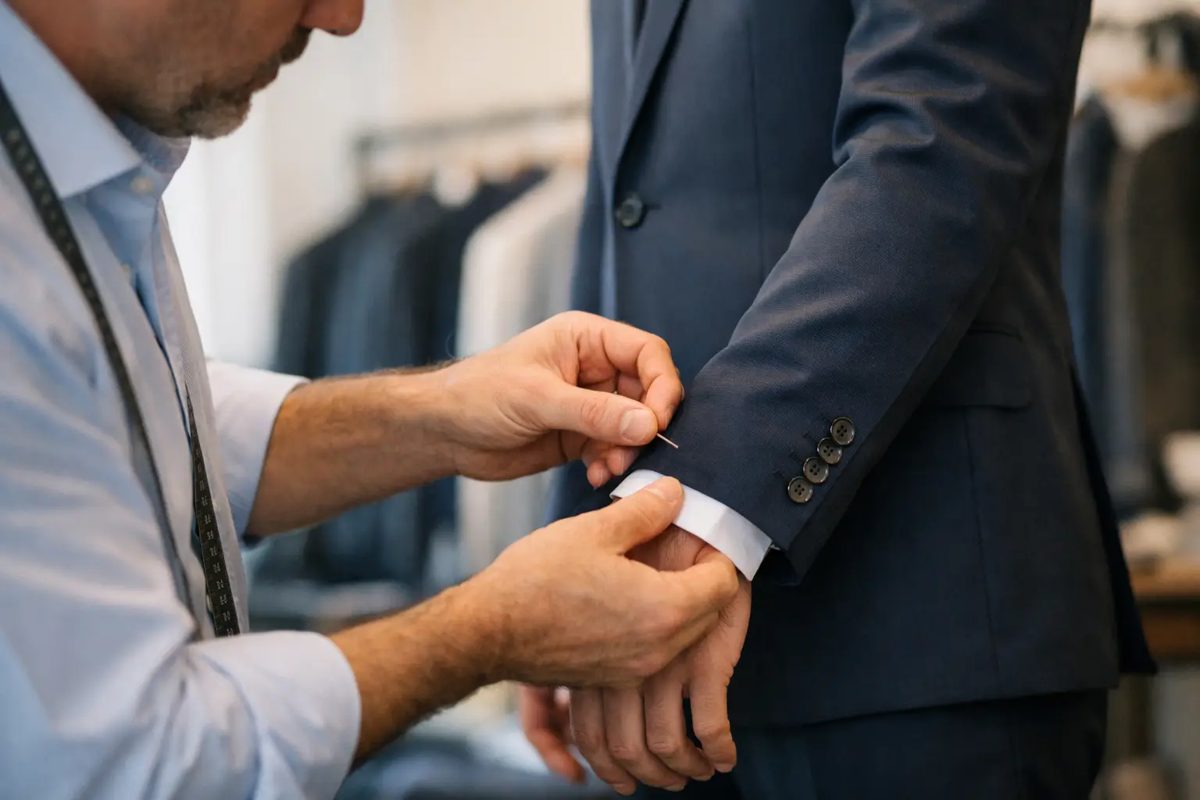
Adjusting the sleeve length of a jacket is not simply an intervention of a few centimetres. The point where the sleeve ends determines how the shirt cuff shows, the structure of the jacket below the shoulder and the discipline of the entire silhouette. Even the finest Loro Piana or Scabal cloth cannot show its full potential if the sleeve length is wrong.
In men's tailoring this detail demands particular attention, because sleeve length is judged both at rest and in movement. A sleeve that completely covers the wrist and hides the cuff looks untidy. An excessively short sleeve, especially on a formal suit, can upset the sense of proportion. The right result depends on the build, the shirt cuff, the construction of the jacket and the purpose of use.
How should the sleeve length of a jacket look?
In the classic measure, the jacket sleeve ends around the wrist bone and roughly 1-1.5 centimetres of shirt cuff show beyond it. This is not an immutable mathematical rule. On a man with long arms and large wrists, or with a shirt that has a thicker formal cuff, the visible portion may differ slightly. The essential criterion is that a considered, clean transition is created between shirt and jacket.
To check the measurement, the arms should hang naturally at the sides of the body. It is then useful to extend the hands forward, sit down and fasten the jacket button. Deciding only while standing motionless before the mirror is not right: at a daily meeting, when getting into a car or sitting at a desk, the behaviour of the sleeve changes.
The choice of shirt also plays an inseparable role at this stage. Shortening the jacket sleeve without taking the shirt cuff into account can later make the look of the cuff irregular. In personally made shirts in particular, the height of the cuff, the set of the sleeve and the size of the watch should be considered together.
What is examined when assessing sleeve length?
A professional tailor does not measure only the end of the sleeve. He looks at the shoulder line, the direction in which the sleeve turns, the point of the elbow and the client's natural posture. Sometimes the problem appears to be one of length, but the real cause is a dropped shoulder seam or excess cloth in the sleeve. In such a case, shortening the end alone does not fully correct the appearance.
The way the jacket is used also influences the decision. On a dark blue or charcoal business suit, the classic cuff appearance should be kept more precisely. On a summer jacket of softer construction, made for instance from a lightweight cloth such as Drago or Reda, a slightly more relaxed expression may be acceptable. Even so, ease does not mean carelessness.
For men who wear a watch there is an additional nuance. If a watch with a large case pushes the cuff up, the sleeve length should not be assessed without the watch on. The tailor should set the measurement according to the client's real habits of wear. This is one of the fundamental differences between personal tailoring and ready-to-wear.
The buttons determine the level of intervention
Shortening from the end of the sleeve is technically the simplest method, but it is not considered the ideal solution for every jacket. If the sleeve has working buttonholes, shortening can disturb the distance between the buttons and the edge of the sleeve. If the buttons appear too low or too high, the proportion of the jacket suffers.
On ready-to-wear models, decorative buttons sometimes give the tailor more scope. But on high-level bespoke and made-to-measure jackets, functioning buttonholes, hand-worked details and the construction at the sleeve end call for a more cautious approach. Small adjustments are usually made with ease. A large shortening, however, in some cases requires the sleeve to be detached at the shoulder and reset.
This method is more complex and more expensive, but it allows the position of the buttonholes, the elbow line and the overall proportion to be preserved. Not every jacket needs it. The decision should be made only after considering the cloth, the lining, the shape of the sleeve and the number of centimetres required.
When is adjusting jacket sleeve length risky?
The safest intervention is usually a small shortening. Lengthening has more limited possibilities, because there must be spare cloth at the end of the sleeve. In some ready-to-wear jackets this reserve amounts to only a few millimetres. In older models or jackets that have been altered before, stitch marks, differences in colour and fading from the sun may come to light.
Shortening the sleeve by more than 3-4 centimetres should also be assessed with care. The position of the buttonholes, the taper of the sleeve and the proportion of the elbow may change. In striped, checked or noticeably textured cloths especially, the continuity of the lines is important. The tailor must preserve not only the length but the way the pattern sits on the sleeve.
Intervention from the shoulder requires a professional hand. The armhole, the sleeve head and the lining are reworked. The technical requirements of a softly constructed Italian-style jacket and a more structured English cut are not the same. It would therefore be wrong to approach every alteration with the same price and the same method.
Why is measuring at home not enough?
Estimating sleeve length at home with a tape measure can give an initial idea, but it is not sufficient for the final decision. People very often hold one shoulder slightly lower than the other, the height of the wrists differs, and their everyday posture changes from the pose they adopt in front of the mirror. Although these differences are measured in millimetres, they are clearly felt in the look of the suit.
In addition, the shirt worn under the jacket, the padding at the shoulder, the inner lining of the sleeve and the weight of the cloth affect the result. The same measurement may not feel the same in a heavy winter cloth and a fine summer wool. When the tailor assesses the jacket together with the shirt the client wears and, where possible, with personal elements such as shoes, belt and watch, the result is more precise.
How is this detail resolved in bespoke tailoring?
In bespoke tailoring, the sleeve length is set at the initial measuring, but the final decision is made at the first fitting. At this stage the tailor watches the client's arms in natural movement, checks how the cuff shows and takes into account any possible asymmetry between the two arms. The aim is not simply to obtain the same figure, but to create an equally balanced appearance on both sleeves.
At Atelier Baku 1984, this approach is built together with the overall silhouette of the jacket. The proportions of shoulder, chest, waist and sleeve are not separate from one another. The chosen cloth is also part of the decision: the fluid wool of Zegna, the more formally structured cloth of Dormeuil or the soft texture of Piacenza 1733 can each affect the fall of the sleeve differently.
A good result very often goes unnoticed. The sleeve of the jacket looks neither short nor long; it simply creates a natural harmony with the shirt cuff, the watch and the movement of the hand. It is precisely this silent precision that is one of the most convincing signs of quality in a man's wardrobe.
The next time you put on a jacket, do not look only at the overall image in the mirror. Consider, too, that small proportion visible beside your wrist: sometimes it is exactly this that determines the whole level of the garment.