

Jacket Lapel Types: Notch, Peak and Shawl
Two identical navy jackets can hang side by side: the same cloth, the same size, the same number of buttons. Yet one looks composed and precise, the other heavy and dated. The difference often rests on a single detail — the shape of the lapel, its width, and the way it lies on the chest.
The jacket lapel is the most looked-at part of a suit. It is exactly where the eye falls in conversation: below the face, between the shoulder and the chest. Choosing a lapel is therefore not decoration but a way of building the silhouette.
The three principal shapes
The notch lapel is the most common and the most neutral. Where the lapel meets the collar, a triangular step is left open. This shape is the standard of the business suit, the odd jacket and almost every everyday model. It draws no attention to itself, and that is what makes it the most versatile.
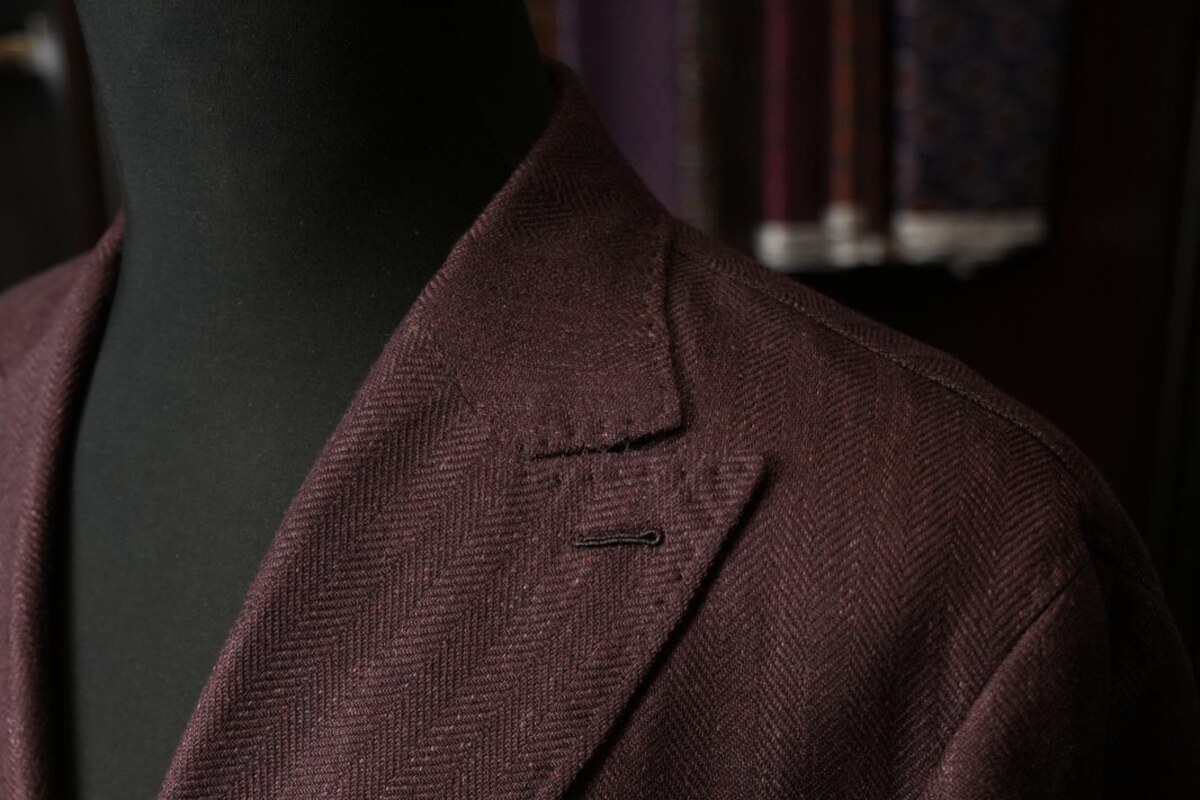
The peak lapel has sharp points directed upwards, towards the shoulder. It carries the eye upward, makes the shoulder read a little wider and the silhouette taller. The peak is the natural shape of a double-breasted jacket: in a double-breasted model it is used almost without exception. On a single-breasted suit it adds formality and a hint of ceremony.
The shawl collar runs in one soft, unbroken curve. Its place is in evening dress: the dinner jacket and the smoking jacket. In a daytime business suit a shawl collar looks out of place; on a dinner jacket, faced in silk, it is the quietest and most elegant answer of all.
Other variants exist — lapels with lowered points, or a tailor's own reading of the classic shapes — but in a bespoke commission the real decision is made among these three.
The gorge line: how high the notch sits
The seam where the lapel meets the collar is called the gorge. Its height matters no less than the shape itself, because it changes the proportion of the whole upper body.
A low gorge drops the notch and makes the chest read wider and the neck shorter. That construction belonged to certain periods of the past, and today it is most often the first thing that dates a garment. In ready-made suits the fault appears regularly.
A raised gorge does the opposite: it lengthens the line, makes the neck look slimmer and the torso taller. Italian tailoring favours this construction. The measure lies in proportion: a notch pushed too high makes a jacket look artificial and strained. This is precisely where bespoke shows its value — the gorge is set to the length of your neck and the slope of your shoulder.
Lapel width and the proportion of the chest
Lapel width should follow the build rather than the fashion. The general rule: the lapel echoes the relationship between the width of the shoulder and the volume of the chest.
On a broad-shouldered man with a full chest a narrow lapel does not work — the jacket looks large above and small in the detail. Conversely, on a slim frame an over-wide lapel pulls the shoulder down and weighs the torso.
A medium width is the classic proportion, and it stays right for years. Very narrow and very wide are the outer edges of fashion: after a few seasons they begin to announce their date. For a wardrobe meant to last, a width near the middle is the sounder choice.
Lapel width is also settled against the size of the pocket flap, the placing of the buttons and the volume of the tie knot. These are not separate details but one system.
How the lapel is built: canvas, the iron and a soft roll
How the lapel lies matters as much as its shape. In a good jacket the lapel is not pressed into a flat fold: it turns in a soft curve and stands very slightly away from the chest. That roll is what gives a suit its life.
The result comes from the construction inside. In a canvassed jacket the layer beneath the lapel is padded by hand or by a saddle stitch and shaped to the body; in time the lapel takes the form of its owner's chest. In a fused jacket the lapel stays flat and inert — tidy at first glance, but lifeless.
The second condition is the iron. The line of the roll is shaped with the iron, not crushed into an edge. A sharply pressed, knife-edged lapel is among the plainest signs of a cheap garment.
The buttonhole on the left lapel is a detail of its own. In bespoke commissions it is worked by hand rather than by machine: the edges come out dense, the surface slightly raised, and it catches the light differently. It is one of those differences invisible from across a room and obvious at close range.
Which lapel for which occasion
For an everyday business suit the notch is the soundest choice: quiet, versatile, at home in any setting. It is the logical place to begin a first bespoke suit.
On a double-breasted jacket the peak is the rule. On a single-breasted suit it belongs to more formal occasions: a ceremony, an evening engagement, a wedding. For an ordinary office it can read as rather too grand.
For a dinner jacket the choice lies between shawl and peak; both are correct and both are faced in silk. A notch lapel on a dinner jacket, however, does not answer the tradition — this is among the most repeated mistakes.
How the lapel is chosen in bespoke
A decision about the lapel is not made by picking a picture from a catalogue. When measurements are taken, the slope of the shoulder, the length of the neck, the volume of the chest and the posture are all recorded; shape, width and gorge height are then fitted to those figures.
The practical approach runs like this: the first suit takes a medium-width notch with the gorge set to your neck. The second and third commissions add a peak, a more characterful width, or a shawl for a dinner jacket. In that order a wardrobe never repeats itself.
At Atelier Baku 1984 the lapel is never discussed apart from the cloth: the weight and the weave decide directly how the lapel will roll. The result is a lapel built to the proportions of one man rather than of a catalogue model.