

Should a jacket be buttoned, and when?
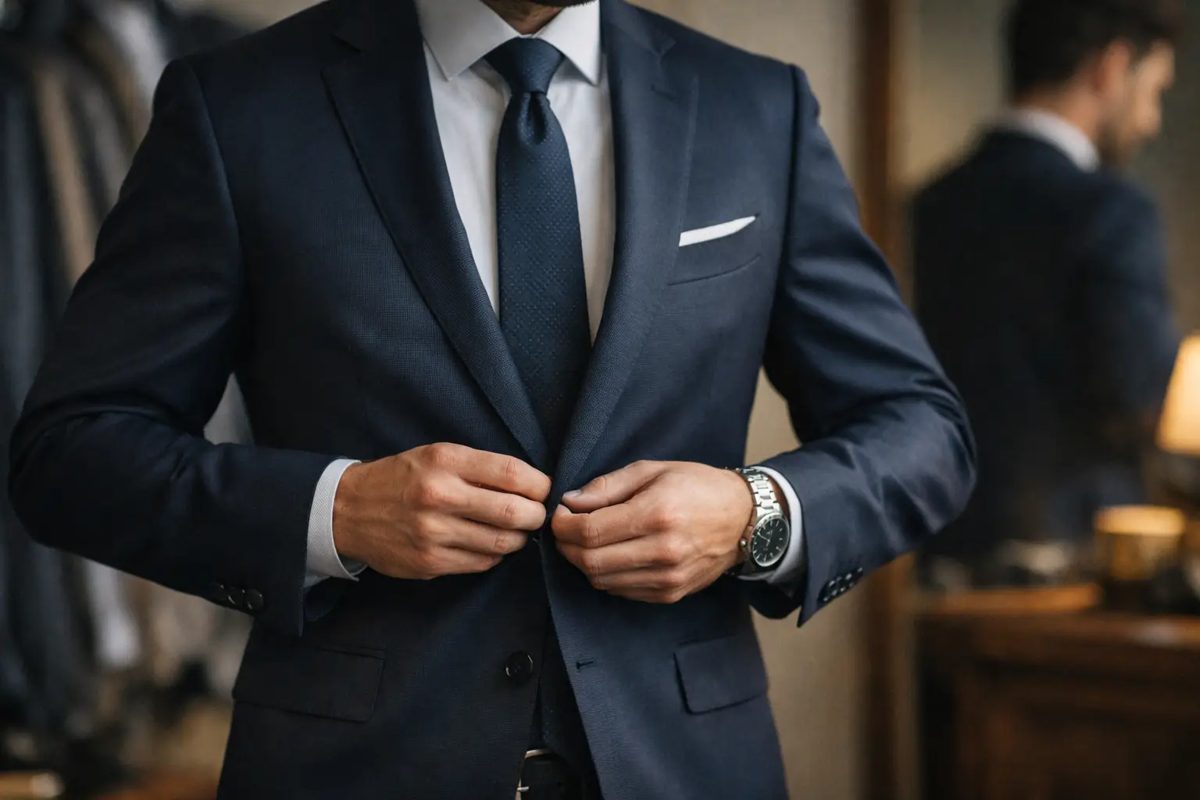
The short answer to the question "should a jacket be buttoned?" is this: standing, usually yes; sitting, no. Yet for a well-dressed man this is not merely a rule of etiquette. The moment at which the button is fastened is a subtle detail that reveals the construction of the jacket, the balance of the silhouette and how the cloth works on the body. On a jacket made to personal measurements in particular, this simple gesture either completes the intention of the cut or undoes it.
In classic men's tailoring the rules may look formal, but behind them stand both history and practical logic. The number of buttons, the cut of the jacket, the character of the occasion and the build of the wearer determine how that logic is applied.
Should a jacket be buttoned: the basic principle
When standing, the jacket should frame the body and look compact at the chest and waist. Fastening the button serves precisely this purpose. An open jacket can make a more relaxed, less formal impression; but at a business meeting, an official reception, a presentation or when being photographed, a fastened button usually creates a more composed silhouette.
Unbuttoning when sitting is a constructional necessity more than a courtesy. The tension that arises around the hips and stomach when seated pulls at the fronts of a buttoned jacket, opens the side vents and disturbs the natural fall of the cloth. In fine, high-quality wools such as Loro Piana, Dormeuil, Scabal or Zegna, this strain shows immediately. Unbuttoning both allows ease of movement and preserves the shape of the jacket.
Refastening the button with a calm gesture on rising is one of the most natural signs of classic good manners. This gesture should be understood not as a display, but as an expression of attention to one's clothing and one's surroundings.
The correct rule for a two-button jacket
The most widespread choice in modern bespoke suits is the two-button jacket. Here the rule is simple: the top button is fastened, the bottom button is left open.
Leaving the bottom button undone is not an arbitrary tradition. The roll of the lapel, the position of the buttons and the flare of the skirts are built on the assumption that the top button will be fastened. When both buttons are done up, the front of the jacket is over-stretched, the skirts pull apart and the waistline looks artificial. On a correctly cut jacket, fastening the top button produces no tightness across the chest, the waist is lightly emphasised and the skirts fall freely and cleanly.
There can be only one exception to this rule: certain jackets with a very high buttoning point and a particular historical cut. But on a classic two-button business or ceremonial jacket, fastening the bottom button is not considered correct.
What should the cloth say when the button is fastened?
If deep X-shaped creases appear across the front after buttoning, the problem is not ignorance of etiquette but the fit. It may mean the waist is too tight, the chest too narrow or the size simply wrong. On the other hand, if the jacket stands too far from the body when buttoned, the silhouette loses its strength.
In bespoke tailoring, the buttoning point is determined by the client's height, the line of the stomach, the structure of the shoulders and his everyday movement. This is why the same rule does not give the same visual result on every man. Correct buttoning cannot take the place of a good cut, but it makes the quality of that cut visible.
Which buttons are fastened on a three-button jacket?
A three-button jacket creates a more classic, more vertical appearance. The traditional rule is expressed as: sometimes the top, always the middle, never the bottom. In other words, the middle button is the main fastening point and the bottom button remains open. Whether the top button is fastened depends on the lapel line of the jacket and the position of the buttons.
If the jacket has three buttons but its lapel rolls naturally down to the middle button, in the "three-roll-two" construction, it should in practice be worn as a two-button jacket. The top button may appear decorative; the middle button is fastened and the bottom one left open. This cut looks especially elegant on the soft-lapelled, naturally constructed jackets of Italian tailoring.
Fastening all three buttons can make sense only on certain uniforms, stage costumes or models with a deliberate design intention. On a classic city suit this choice very often weighs down the line of the jacket.
The one-button jacket and the tuxedo
On a one-button jacket the rule is clearer still: fastened when standing, open when sitting. This model is usually found in evening dress, on the tuxedo (dinner jacket) and in more refined formal silhouettes. A single button placed at the waistline lengthens the torso and gives a minimal, clean appearance.
On a tuxedo jacket, too, it is proper to fasten the button when standing. Unbuttoning when sitting matters both for comfort and so that the satin or grosgrain lapels stay flat. No belt is worn here; the waist is usually completed with a cummerbund or a waistcoat. For this reason, what shows beneath the open jacket must also be a considered element of the whole composition.
Buttoning with a waistcoat
With a three-piece suit, leaving the jacket open can look more natural, since the waistcoat maintains the discipline of the silhouette. Even so, at an official reception, when greeting someone standing or when making a speech, buttoning the jacket still creates a more compact impression.
On the waistcoat itself, the last button is usually left open. This tradition serves both ease of movement and the preservation of the waistcoat's straight line. The waistcoat should be neither too short nor too long, nor overly tight across the chest. Since its quality becomes more visible when the jacket is open, the fit of the waistcoat cannot be treated carelessly.
When can a jacket be left open?
Rules look rigid when they ignore circumstances. At a more informal lunch, in a creative environment, in hot weather or on a long car journey, leaving the jacket open is entirely acceptable. But an open jacket should look deliberate, not accidental. The shirt collar, the knot of the tie, the waist of the trousers and the skirts of the jacket attract more attention at that moment.
A man who wishes to wear his jacket open must be especially sure that it fits correctly. If the shoulder line is not in place, the sleeve length is wrong or the shirt cuff shows too much, an unbuttoned jacket does not hide these flaws. On the contrary, it brings them to the fore.
Fit matters more than the buttoning rule
Knowing the classic rules is valuable, but subjecting every jacket to the same rule is not the right approach. A soft-shouldered Neapolitan jacket worn with high-waisted trousers may be intended for a more relaxed, open look. A more structured English cut gives a stronger, more formal silhouette when buttoned. The weight of the cloth also plays a part: a jacket made in a light summer wool is more sensitive to movement, whereas a densely woven winter cloth holds its shape differently.
When a jacket is made to personal measurements at Atelier Baku 1984, the buttoning point is not chosen from a size chart alone. The client's standing posture, his habits when sitting, his working routine, the way he uses the garment at events and the cloth he has chosen are considered together. The aim is to create a jacket that looks equally natural whether the button is fastened or open.
The next time you put on your jacket, do not regard the button as a small accessory. It is the central point of the cut: standing, it gathers the silhouette; sitting, it opens to let the cloth breathe; and it displays the quiet precision of good tailoring.