

A Black Tie Guide for Men
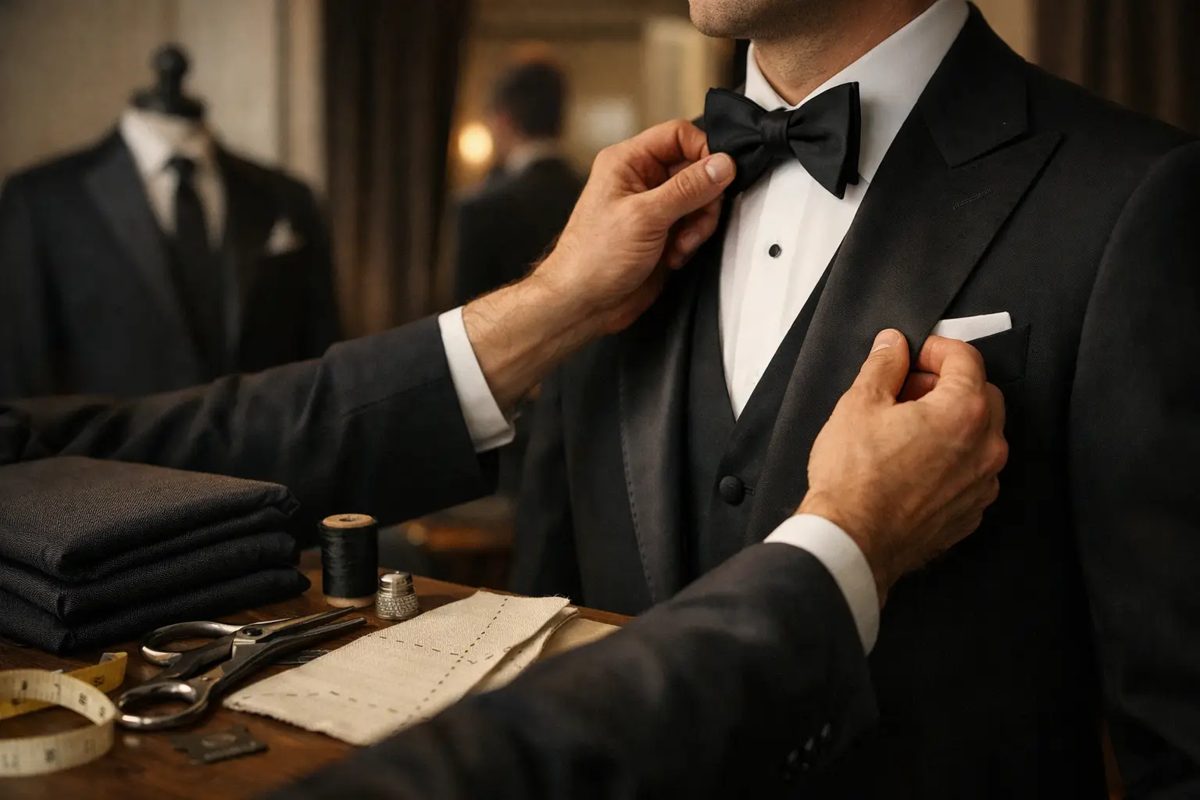
At a black tie occasion, the first thing one notices is not a brand, a logo or a shine. It is how quietly the jacket sits on the shoulder, how the lapel catches the light, how the trousers fall onto the shoe, and how natural the bow tie looks at the neck. This black tie guide is written for men who want to read those differences correctly. The rules are strict, but their purpose is not to restrict: they give evening dress a clear, restrained and shared language.
The phrase black tie does not mean a black suit. It is a specific evening uniform, and at its centre stands the tuxedo (dinner jacket). Chosen well, a tuxedo does not ask for attention; it quietly expresses the respect its wearer shows to himself, to the occasion and to his host.
A black tie guide: read the invitation correctly
If the invitation says “Black Tie”, the standard choice is a black or midnight blue tuxedo. Midnight blue, especially under warm light, can look deeper and richer than black. Even so, for a man ordering his first tuxedo, a high-quality black wool remains the safest and most enduring decision.
“Black Tie Optional” allows a wider frame, but it should not be read as permission to wear an ordinary office suit. The standing of the host, the venue, the hour at which the event begins and the profile of the guests set the direction here. At a diplomatic reception, a charity ball or an official ceremony, the tuxedo is still the most correct choice. At more creative invitations, a measured individuality in colour and texture is possible, but without breaking the essential code.
If the invitation reads “Creative Black Tie”, a velvet dinner jacket, a deep burgundy or dark green tone, or a bow tie in a different texture can be considered. The boundary here is simple: individuality must not replace silhouette and etiquette. The guests’ attention should be drawn to your presence, not to your clothes.
The structure of the tuxedo: cut comes before everything
The value of a tuxedo shows first of all in its cut. The shoulder line should sit precisely without constraining the body, the lapel should lie flat against the chest without gaping at the neck, and the chest of the jacket should form a clean line without pulling. Tense X-shaped creases across the front when buttoned reveal that the size is too small. An overly generous jacket, on the other hand, can make even the most expensive cloth look shapeless.
The classic tuxedo jacket may be single-breasted with one button, or double-breasted for a more formal effect. The single-breasted model is more universal and adapts comfortably to most builds. The double-breasted model demands correct proportion and bearing: on a tall man or one with strong shoulders it can look magnificent, but on a short torso it carries the risk of weighing down the front.
The choice of lapel is not incidental either. The peak lapel gives a more formal and more vertical impression. The shawl lapel has a soft, unbroken line and looks particularly elegant at classic ceremonies. In both cases, the silk facing of the lapel — usually grosgrain or satin — should belong to the same family of material as the bow tie and the stripe on the trouser.
In bespoke tailoring these details are inseparable from the measurements. The width of the lapel, the position of the button, the pitch of the sleeve and the shape of the waist are built around the proportions of the body. In ready-to-wear one can find an approximate size, but when shoulder, sleeve length and waist are not right at the same time, the result remains a compromise.
Cloth and colour: a decision made under the light
Cloth for a tuxedo must behave differently from that of a day suit. Wool that is too thick, coarse or loosely woven looks heavy in evening light. Overly glossy synthetic blends, meanwhile, can create a cheap shine in photographs. A dense, fine, well-draping pure wool is the most reliable choice. Classic weaves such as barathea receive the light calmly and preserve the depth of ceremonial dress.
The weight of the cloth depends on the season and the temperature of the venue. For an indoor winter event in Baku, a somewhat fuller wool is a comfortable and orderly choice. At a summer reception or in a warm hall, a lighter, breathable cloth gains the advantage. In the collections of cloth houses such as Loro Piana, Dormeuil, Scabal and Zegna, the difference lies not only in the name but in the quality of the yarn, the density of the weave and the way the cloth behaves on the body.
The white dinner jacket calls for a rule of its own. It is technically not white but closer to an ivory tone, and it is intended for warm climates, open-air or summer evening events. It is completed with black trousers, a black bow tie and black formal shoes. At a winter ball or a serious evening dinner, black or midnight blue is more appropriate.
Shirt, bow tie and the waistline
A tuxedo shirt differs from a plain white shirt in more than colour. Its collar must accept a bow tie, and its front must have a more formal construction. The turn-down collar is the most practical and classic choice. A piqué or finely textured bib creates a distinctly ceremonial feeling, though a modern, plain-fronted white shirt with the right construction is also entirely suitable.
The bow tie should be of black silk and, ideally, tied by hand. A pre-tied version may look tidy enough from a distance, but the slight asymmetry of a hand-tied bow creates a livelier and more convincing impression. A long tie, however fine the seven-fold silk it is made from, does not replace the classic black tie code.
The waist should not be left exposed. The trousers are cut with a higher rise accordingly; with a single-breasted tuxedo, a cummerbund or a low-cut waistcoat completes this transition. The pleats of the cummerbund should face upwards. Historically this detail was conceived for theatre tickets and small items, but today its main task is to preserve visual continuity.
Trousers and shoes: the quiet parts that complete the look
Tuxedo trousers have no belt loops. A belt belongs to the logic of daywear and divides the evening silhouette in two. What matters more is a single silk stripe down the side to match the lapel facing, a flat and clean front, and the correct length that does not gather on the shoe.
The choice of shoe immediately signals the degree of formality of the occasion. The classic opera pump is the most formal answer, but a highly polished black patent leather oxford is also a reliable choice. A velvet evening slipper should be considered only where the venue and the character of the invitation permit it. Brown leather, thick soles, casual loafer-style models and light-coloured socks remain outside this ensemble.
Socks should be fine, black and long enough that no calf shows when seated. It seems a small detail, but in ceremonial dress the overall impression is very often determined precisely by such unseen decisions.
A sense of proportion in accessories
At a black tie occasion, the task of an accessory is not to announce itself but to support the quality of the clothes. Simple black onyx or mother-of-pearl studs, discreet cufflinks and a cleanly folded white pocket square are enough. Rather than shaping the pocket square into something voluminous or colourful, a flat fold or a natural, soft fold looks more refined.
The question of a wristwatch depends on the character of the event. In the most formal approach, no watch is worn, since keeping track of time at an evening ceremony is considered ostentatious. At a modern reception or dinner, a slim-cased watch with a black strap and a plain dial is acceptable. A large sports watch, visible metal bracelets and an abundance of jewellery are at odds with the restraint of the tuxedo.
The most common mistakes
The most widespread mistake is treating a black business suit as a substitute for a tuxedo. Other errors arise from the same logic: wearing a black long tie, using a belt, choosing a button-down collar shirt, or preferring an overly shiny, tightly cut synthetic jacket. Individually these choices may pass unnoticed, but together they break the ceremonial language of the clothes.
Another risk is the attempt to look excessively “modern”. Trousers that are too short, visible logos, a large watch, coloured socks and sporty shoes all weaken the order of black tie. The classic form is not dull, because within it there is ample room for distinction through cloth, proportion, lapel shape and hand-finished details.
Preparing for the event at the last moment is the most practical mistake of all. A bespoke tuxedo in particular requires time for the initial consultation, measurements, cloth selection, fittings and final adjustments. At a bespoke tailoring house such as Atelier Baku 1984, this process is not merely a matter of taking measurements; it is a matter of determining how the tuxedo will serve your occasion, your build and your long-term wardrobe.
As soon as you receive your invitation, read the hour, the venue and the dress code once more. Then make your decision not on the basis of a single detail but of the whole silhouette: the right tuxedo is not an item you put on, but a quiet position you carry with ease throughout the evening.