

Single-Breasted or Double-Breasted Jacket: Which Is Right?
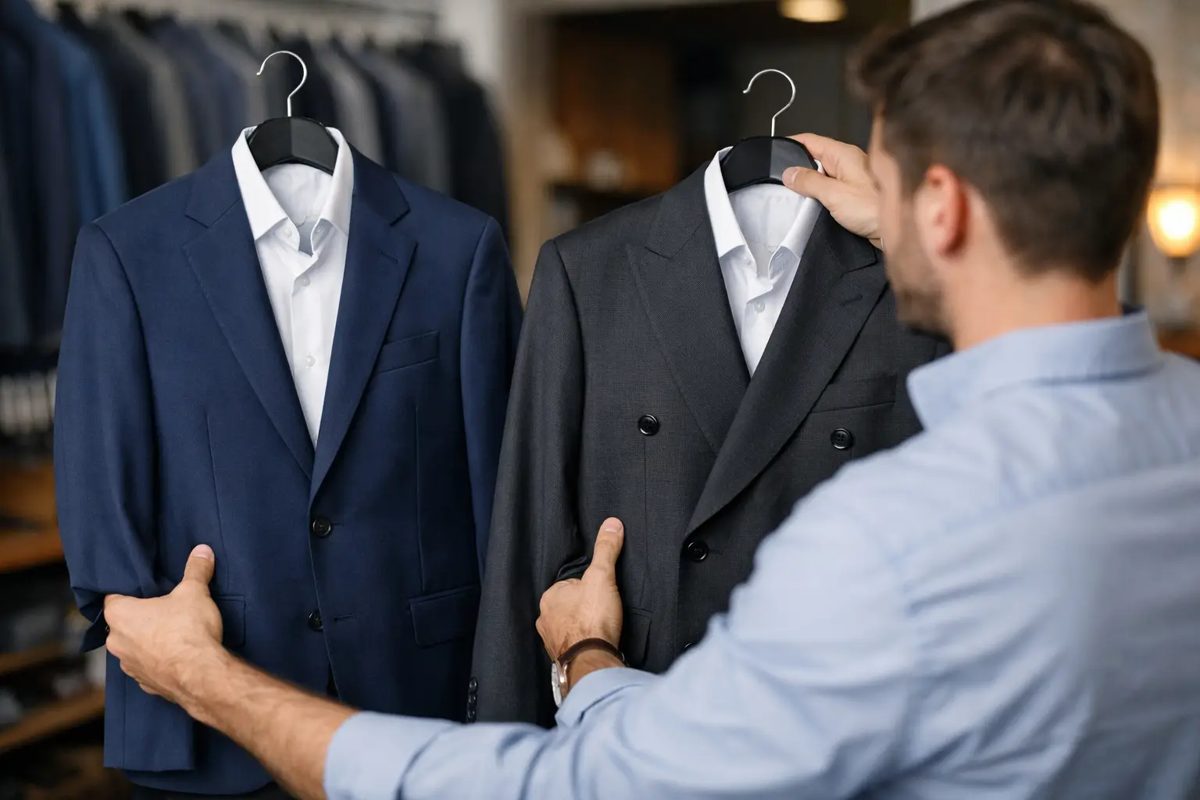
The first impression a jacket gives of a man very often begins not with its colour but with its construction. That is precisely why the choice between a single-breasted and double-breasted jacket is not merely a matter of taste: the shoulder line, the proportion of the chest, the shape of the waist and the setting in which the jacket will be worn all play a direct part. A well-chosen model looks calm, assured and measured. A poorly chosen one can weaken the effect of even the most precious cloth.
In bespoke tailoring, the first question is rarely “which model is more fashionable?” The better question is this: which cut sits more naturally with your build, your daily rhythm and the places you frequent? The single-breasted jacket is distinguished by its versatility; the double-breasted jacket creates a more expressive stance and an architectural precision.
The essential difference between single-breasted and double-breasted jackets
In a single-breasted jacket the front panels overlap relatively little and are usually fastened with a single row of buttons. The most classic version has two buttons. Its open V reveals the shirt, tie and lapel line clearly, and reads the silhouette as lighter and more elongated. Its wide range of use, from business meetings to the everyday city wardrobe, arises from exactly this balance.
In a double-breasted jacket the front panels overlap more generously, and the buttons are arranged in two parallel rows. This construction gives depth to the chest and a more defined contour to the shoulders. When the jacket is fastened the waist appears more compact, and to keep its shape when left open, the cut and the inner construction require particular precision.
The difference is not only in the number of buttons. The single-breasted model carries a more open and relaxed rhythm. The double-breasted model looks more formal, more ordered and somewhat ceremonial in character. That said, reserving the double-breasted jacket solely for official receptions is an outdated approach. Made up in a light wool, fresco, a cotton-wool blend or a breathable open-weave cloth, it becomes a very natural choice for a business lunch or an evening meeting in Baku as well.
Which silhouette suits whom?
The single-breasted jacket is the safest starting point for a variety of builds. For men of medium or relatively short height in particular, a two-button model with a button position that is not too low can visually lengthen the line of the leg. A cut that is not tight yet controlled at the waist ensures the jacket neither constrains the body nor looks loose.
On broad-shouldered men of athletic build, the single-breasted model creates a clean, calm proportion. Here the width of the lapel, the height of the pocket flaps and the position of the button must be calculated individually. The problem frequently encountered in ready-to-wear is this: the chest and shoulder measurements fit, but the waist is left with excess. A bespoke cut removes that discrepancy.
The double-breasted jacket, meanwhile, looks especially striking on tall men of medium or slender build. Its overlapping front gives the torso breadth and structure. This does not mean, however, that men of larger build should stay away from the double-breasted model. What matters is that the front panels are not excessively wide, that the button point is correctly placed, and that the jacket has sufficient shape at the waist.
A jacket that is too short, or a button position that is too high, can upset the proportions of the double-breasted model. Conversely, the right length, a natural shoulder and a waist given a graceful shape make this model a strong but never ostentatious choice. The double-breasted jacket commands attention, but it should not shout.
The rule of buttoning is part of the look
On a single-breasted two-button jacket, usually only the top button is fastened. When seated, unbuttoning the jacket is correct both for comfort and for preserving the construction. On the classic three-button model, the middle button is the main fastening point; the bottom button is left open.
The double-breasted jacket shows its character most fully when fastened. On modern, well-cut examples it can be unbuttoned when seated, but the balance of the model is clearer when it is closed. It is not obligatory to fasten every button: the chosen buttoning scheme should follow the cut of the jacket and the line the tailor intended.
The choice of cloth changes the construction
The same model behaves entirely differently in different cloths. In a single-breasted jacket, the fine merino wools of houses such as Loro Piana or Zegna can create a soft, flowing silhouette. The classic suiting cloths of Dormeuil and Scabal, with their livelier hand, give a neat, shape-holding result for the business wardrobe.
The double-breasted jacket is more demanding in terms of cloth. Because of the extra layer at the front, a very heavy cloth can be tiring in a warm climate. For this reason high-twist wool, open-weave fresco, a light flannel or wool blends with a measured proportion of silk are more appropriate. Alongside the weight of the cloth, its “memory” also matters: how well does the cloth recover its shape after creasing during the day?
For summer, light grey, tobacco, stone and deep blue tones look elegant in both models. Dark navy remains one of the most reliable choices for a first serious suit. In the double-breasted model, large and bold patterns should be approached with caution, since the construction itself is already expressive enough. A delicate chalk stripe or a fine herringbone weave, however, can add measured character.
Business, ceremony and personal style
If there is a daily working schedule, frequent travel and the intention to wear one jacket in various combinations, the single-breasted model is more practical. It pairs easily with formal trousers as well as with well-chosen wool or cotton trousers. A navy single-breasted jacket, a white or light blue shirt and a seven-fold tie in Como silk make a combination that keeps its relevance for many years.
For men in senior positions, or those who attend meetings of a diplomatic or protocol character, the double-breasted jacket is the stronger alternative. It makes a difference particularly at evening events, presentations and ceremonies that call for careful visual discipline. At the same time, it is important that the jacket is not excessively tight and that the shoulders are not artificially rigid. Status should come from the quality of the construction, not from decorative exaggeration.
Personal habit must also be taken into account here. A man who often puts his hands in his pockets, or who spends much of the day in a car or an office chair, should certainly test the comfort of a double-breasted jacket before choosing it. Even the most elegant model cannot be considered the right choice if it restricts its wearer’s movement.
The unseen details of a bespoke cut
The quality of a jacket is not determined only by the lapel and buttons visible at first glance. The natural set of the shoulder, the allowance for movement in the sleeve, the way the collar hugs the neck, the absence of strain across the chest and the absence of horizontal creases at the back are the more fundamental indicators. When these details are right, the jacket looks not as if it were stuck to the body but as a form that moves together with it.
Herein lies the value of a personal consultation at Atelier Baku 1984: the choice of model is made not merely as a visual decision in front of the mirror, but with the client’s posture, working routine and future scenarios of use taken into account. The weave of the cloth, the weight of the lining, the structure of the lapel and the position of the button are not separate from one another; they are parts of a single silhouette.
A man hesitating over his first order can build a reliable foundation with a single-breasted, two-button, navy jacket. If the wardrobe already contains well-fitting classic suits, the double-breasted model adds more character and distinction to it. The right jacket, in the end, is not the one that changes you in the mirror, but the one that expresses your existing position more precisely.