

Half-Canvas and Fused Construction: The Difference
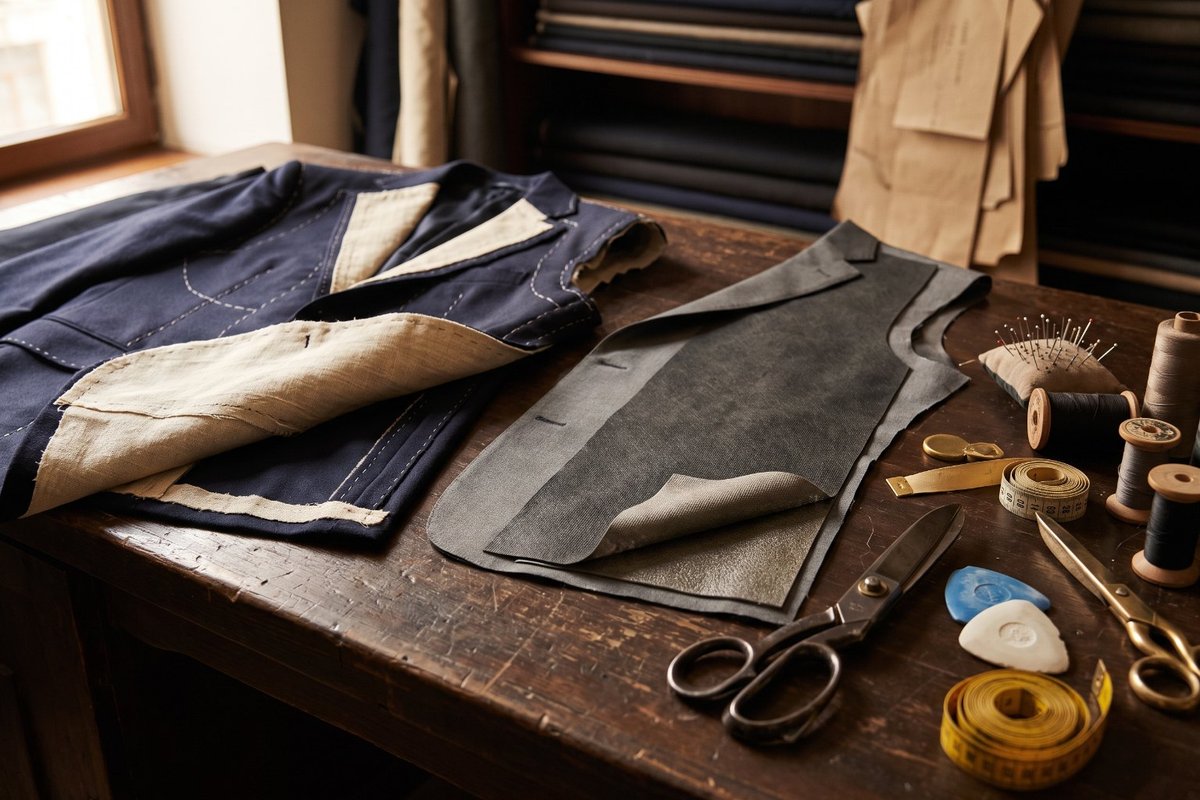
At first glance, the cloth on the outside of a suit seems to say everything. The real difference, however, lies in the roll of the collar, in how the chest holds its shape over time, and in whether the jacket moves together with your body. The choice between half-canvas and fused construction is decided in precisely these unseen layers. The same quality of wool cloth can take on an entirely different character with two different constructions.
In a bespoke suit order, construction is not merely a technical term. It is the fundamental decision that affects the comfort of the jacket at the shoulder, the depth of the chest, its breathability in the summer months and the way it ages over the years. And the right choice depends not only on budget, but on the purpose of the suit, the frequency of its use and personal taste.
What does suit construction determine?
The outer cloth of the jacket, its lining and the inner layers that lie between them together form the construction. The task of these layers is to keep the cloth stable on the body, to give shape to the chest and to ensure that the collar rolls naturally. The two most common approaches are fused construction and half-canvas.
In fused construction, the outer cloth is bonded to a special adhesive interlining. From a manufacturing standpoint it is the faster and more affordable method. In the first wearings it can give a smooth, neat and adequately shaped impression. But this construction partly restricts the natural elasticity of the cloth.
In half-canvas construction, a traditional canvas layer blended from horsehair, wool and cotton is used in the chest and collar zone. Instead of being fixed with adhesive, this layer is stitched or joined by a special method. As a result, the jacket behaves in a livelier, more elastic way against the body and, over time, adapts to its owner’s silhouette.
Half-canvas and fused construction: the essential differences
The difference is felt most quickly when the jacket is put on. In a half-canvas model, the chest does not look entirely rigid, yet it holds its shape. As the cloth moves, the construction works with it. This quality is especially valuable for long days that run from a desk-bound routine to meetings, from travel to evening events.
Fused construction, on the other hand, creates a more fixed and sometimes flatter surface. It can be a sensible choice for relatively light use, a seasonal jacket or an order on a more limited budget. It is not correct to regard it as poor quality on principle. The result depends on the grade of adhesive, the application technology, the weight of the cloth and the work of the tailor.
That said, high temperatures, frequent dry cleaning and long-term use can alter the behaviour of the fused layer. In some cases, small bubbles in the cloth, unevenness of the surface or an artificial stiffness in the collar may appear. This does not necessarily happen in every fused construction, but for a suit made from a valuable cloth and intended to be worn for many years, it is a risk to be taken into account.
In half-canvas, the inner layers age more naturally. Rather than collapsing over time, the chest of the jacket tends to acquire an individual shape. The collar sits more softly against the neck, and the lapel breaks away from the chest in a natural line. This is not a detail that stands out immediately from a distance, but it is exactly this nuance that creates the calm and convincing look of a good suit.
Breathability and comfort
In the climate of Baku, this question has practical significance. In the warm season, the comfort of a suit is not determined by the composition of the cloth alone. The air permeability of the inner layers matters too. A canvas-based construction, especially combined with open-weave wool, wool-silk or wool-linen cloths, regulates the body’s temperature more naturally.
A fused layer, however, can reduce air permeability in a certain part of the cloth. This difference is not felt to the same degree by every client. The needs of a suit worn briefly in an air-conditioned office are not the same as those of an executive on the move all day or a professional who travels frequently. Comfort should be measured not by the eye but by the scenario of use.
Shape, collar and the behaviour of the lapel
In classic men’s tailoring, the collar is the most openly speaking part of the jacket. There should be no gap between the neck and the jacket collar, and the lapel should extend in a natural curve rather than appearing pressed against the chest. Half-canvas construction allows this transition to be built more gracefully.
A clean result is also possible in fused construction, especially in modern, structured models with slim lapels. But how the lapel behaves over time under body heat, movement and steam may not be as natural as in half-canvas. In an everyday business suit the difference may seem subtle; at a formal reception, a wedding or an important presentation, the silent quality of the jacket reads more clearly.
Which construction is right for you?
If you wear your suit several times a week and use it for business meetings, travel and special events, half-canvas is a lasting and logical investment. It displays the potential of a high-quality Dormeuil, Scabal, Zegna, Loro Piana or Piacenza 1733 cloth to better effect. The drape and hand of such materials should not be stifled by the inner layer.
If your aim is a rational choice for a particular season, occasional use or a second suit, a well-executed fused construction can be appropriate. The essential point here is the promise with which it is presented to you. Concealing the construction and presenting every model as belonging to the same category is not the right approach. The tailor should explain this difference openly and give a recommendation suited to the cloth and the intended use.
Full-canvas construction also exists and is regarded as one of the highest levels of traditional tailoring. The entire front, from chest to hem, is worked with a canvas layer. But it is not automatically the most correct option for every suit. It demands more handwork, a higher price and sometimes a longer making time. Half-canvas very often strikes the most correct balance between comfort, shape and value.
What questions should you ask when ordering?
When choosing a suit, do not content yourself with the single question “which mill is the cloth from?” Asking about construction is the natural right of a discerning client. Clarify what material is used in the chest, whether there is a fused layer and how the collar is shaped.
When trying on the jacket, look at the shoulder line, at any strain across the chest and at how the lapel lies along the body. Extend your arms forward, sit down, take a few steps. A quality construction does not restrict movement, and the jacket returns calmly to its place. The best test is not standing still in front of the mirror but feeling how the garment behaves with your rhythm.
At Atelier Baku 1984, these technical decisions are not kept apart from the silhouette during the process of taking measurements and selecting cloth. A navy business suit made from a fine Italian wool and a more structured winter flannel do not have the same needs in construction. The right result emerges when measurements, cloth, cut and inner structure complement one another.
A good suit does not try to change you on the first day. It learns to behave more correctly with you at every meeting, in every movement and in every season. The attention paid to construction is precisely the beginning of that quiet, long-lasting difference.