

Choosing buttons: horn, resin and mother-of-pearl
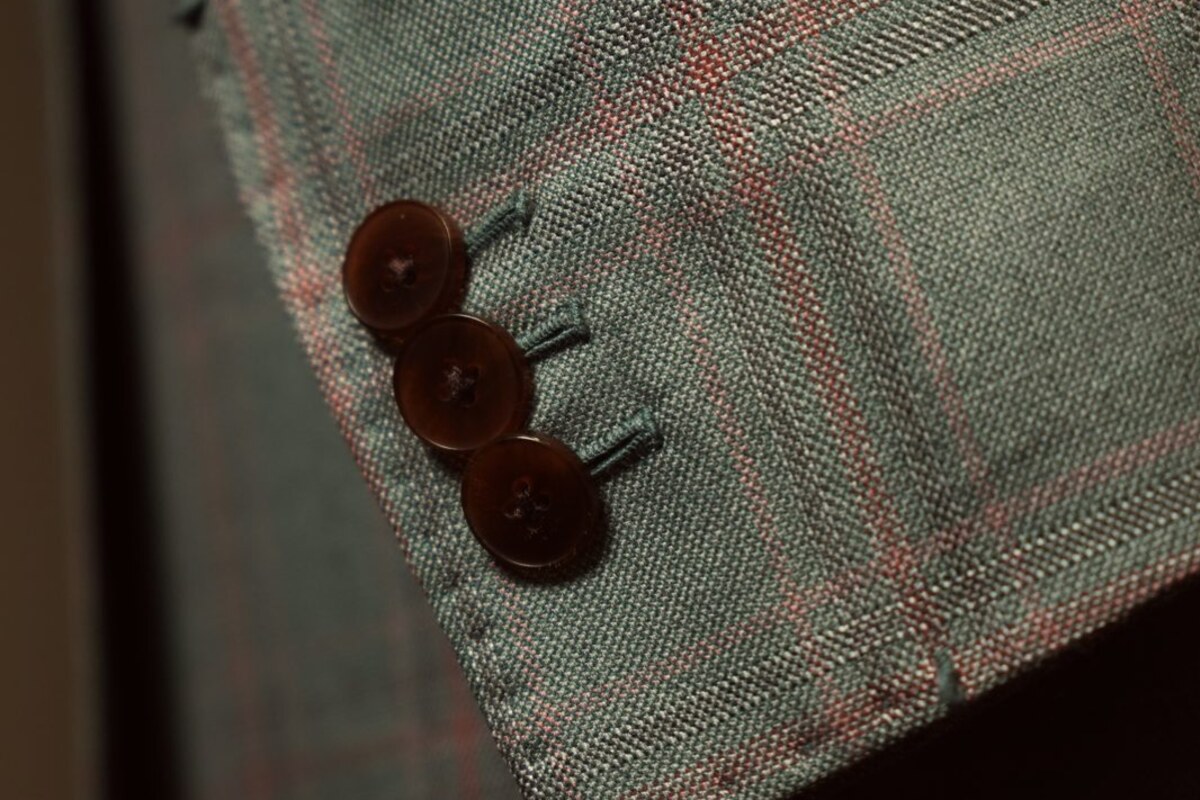
The button is the smallest part of a suit, and most of the time nobody looks at it. Yet the hand touches it every day: fastening the jacket, undoing it, straightening a cuff. No other detail on a suit is used as often.
Button material is also the easiest place to economise unseen. The quality of a cloth is hard to judge from a distance; a button can be picked up and examined — and more often than not it is the button that reveals the first compromise made in ready-to-wear.
Why a button is not a minor detail
There are more buttons on a suit than one tends to think: two or three at the front, up to four on each cuff, five or six on a waistcoat. All are made of the same material and all catch the same light. A badly chosen button is therefore not one mistake but one mistake repeated across the whole garment.
The second question is size. The front button of a jacket is slightly larger than a cuff button, and a shirt button is smaller than either. When that proportion is broken, the jacket looks either heavy-handed or borrowed from someone else's shoulders — and the reason usually goes unidentified.
The third is colour. A button a shade darker than the cloth lets the front read quietly; a sharply contrasting one draws the eye at once and breaks the line of the silhouette. In classic dress the button completes the cloth rather than competing with it.
Horn buttons: how to recognise them
A horn button is a natural material — cut from horn, shaped and polished. Its defining quality is that it cannot be repeated: the veining and the light and dark bands fall differently on every button. Two buttons on the same suit are never quite identical.
This can be tested by hand. Horn stays cool at room temperature and takes the warmth of the hand slowly, while plastic warms at once. Held up to the light, the shift in colour appears within the depth of the material rather than on its surface — it has not been painted on.
The edge differs too. The edge of a polished horn button is a little soft and slightly irregular, because every piece is worked on its own. On a moulded button the edge is identical to mathematical precision, and a fine casting seam often remains.
There is a weakness as well: horn is a natural material and can dry out if it is kept for long in a hot, dry place. Preventing that is simple — do not store the suit beside a radiator or in direct sun.
Resin and plastic: where the difference shows
On most ready-to-wear, buttons are moulded from resin or polyester. It is a cheap and stable solution: thousands of buttons come out exactly alike, the colour matches the catalogue, and nothing breaks in transit.
The difficulty is in the appearance. A moulded button returns light identically at every point, and it is precisely that evenness that makes it read as artificial — particularly next to a matt woollen cloth. On a good suit every surface has a life of its own; a perfectly even gleam falls outside that harmony.
There is also a material in between — corozo, the hardened kernel of the tagua nut. It is natural, matt-surfaced and takes dye deeply. It is a sensible middle path between horn and plastic, and is often found on good ready-to-wear.
Mother-of-pearl and shirt buttons
On a shirt a button works to a different logic. It must be thin enough not to show under the collar or under a waistcoat, and at the same time hard enough not to be damaged under the iron.
Mother-of-pearl satisfies both conditions. It is cut from the inside of a shell, is naturally thin and strong, and its surface returns light from several layers down — which is why a mother-of-pearl button changes colour as it is turned.
Telling it from a plastic imitation is easy as well. Mother-of-pearl is cool, heavy for its size, and fine layers can be made out along the edge. An imitation is light, and its shine stays on the surface with no depth behind it.
On a shirt, mother-of-pearl is usually taken in white or milk, because its task is not to be noticed. On a good shirt the button shows itself only from close to, when light falls on it — it is a quiet detail.
How a button is sewn: shank, thread and rhythm
How a button is sewn matters as much as the button itself. On a jacket it should not sit flush against the cloth: a small gap — the shank — is kept between the two. That gap makes room for the thickness of the cloth when the jacket is fastened, so the front is not pulled.
The shank is built from thread: once the button is sewn on, the thread is wound several times between button and cloth and secured. On a coat and in heavy cloth the shank is longer; on a shirt there is virtually none.
The thread is chosen as well. Handwork usually calls for silk — it is strong and keeps its lustre over time. On a four-hole button the threads are laid either as two parallel lines or crossed; both are correct, and what matters is that one rhythm is kept across the whole garment.
The cuff is a case of its own. On a working cuff every button has its own buttonhole and the sleeve genuinely opens, whereas on a decorative cuff the buttons are simply sewn on top. Setting the buttons close enough to touch one another is a recognised tailoring arrangement, and it is always done deliberately.
How we do it
At Atelier Baku 1984 buttons are chosen mainly in horn, and mother-of-pearl is used on shirts. The reason is not only aesthetic but practical: both materials hold their colour and their surface over years, while plastic polishes itself dull.
The colour of the button is settled after the cloth has been chosen and next to the cloth itself, never from a catalogue. Two different horn buttons give entirely different results on the same navy cloth, and that can only be seen with them laid side by side.
Choices of this kind are invisible on the first day. They show later — once the suit has been worn for several seasons and the buttons are still as they were.