

The Hand-Sewn Buttonhole and the Milanese
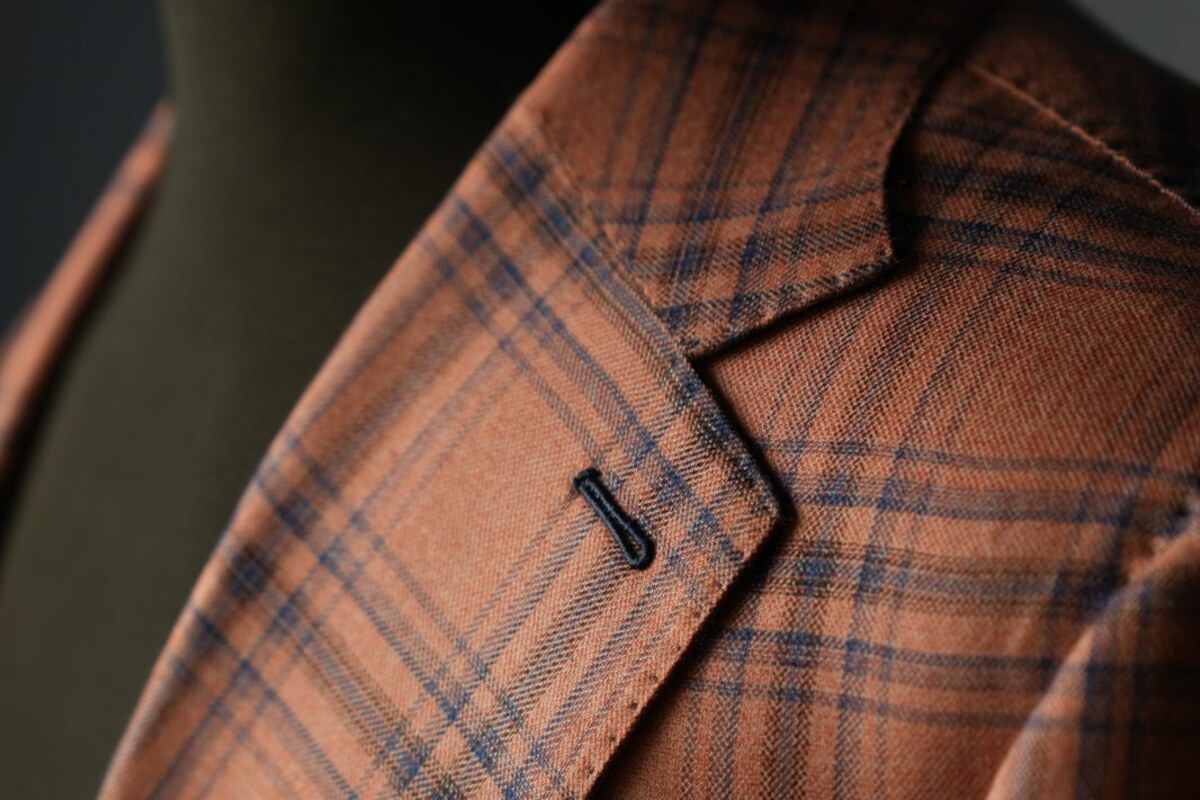
The quickest way to judge a suit is not to look at the label. It is to look closely at the buttonhole on the left lapel. It is small, it is usually never used, and yet it tells you more honestly than any other detail how the jacket was made.
A hand-sewn buttonhole is work that cannot be hidden. It cannot be hurried, cheapened or imitated by machine: the result shows at once. That is why in tailoring the buttonhole is always looked at on its own.
Why the buttonhole is a suit's most honest detail
Cloth can be bought, a lining can be chosen, a button can be swapped. All of that is a question of materials. A buttonhole is a question of time and of hands alone — you cannot buy it, it has to be sewn.
One buttonhole takes a tailor between half an hour and an hour. And a jacket does not have one: there is the lapel, the front where the buttons fasten, several on each cuff. Hand-worked buttonholes therefore add real labour to a commission, and they never appear by accident.
More important still: the buttonhole is one of the most loaded points in a garment. The cloth is cut there, which makes it the weakest place. How the buttonhole is worked decides how the suit will look five years from now.
Machine and hand: where the difference shows
A machine buttonhole is flat. A dense zigzag sits on the surface of the cloth and the cut edge is covered with a fine thread. From a distance it looks tidy, but the surface is matt and lifeless.
In a hand buttonhole the thread is knotted at every stitch. Those knots build a small ridge along the edge of the cut — the buttonhole breathes, it changes under the light and it moves with the cloth. The difference is not obvious at first glance; it becomes clear close up, and with time.
Time is decisive here. As a garment is fastened and unfastened again and again, a machine buttonhole starts to open at the edge, the thread breaks, the cut widens. In a hand buttonhole each knot holds its own place: if one thread goes, the buttonhole does not unravel.
The third difference is the thread. A hand buttonhole is usually worked in silk — bright, strong and fine. That is why a good hand buttonhole reads as a quiet point of light on the surface of a suit, especially on matt wool.
The Milanese buttonhole — occhiello milanese
The most demanding of all hand buttonholes belongs to the Milanese school. The Italians call it the occhiello milanese, or asola lucida — the "glossy buttonhole".
The difference lies in its construction. In an ordinary hand buttonhole the thread goes straight onto the edge of the cut. In the Milanese, a fine cord is first laid along the edge, and the silk is then worked over that cord, stitch against stitch, extremely densely. The edge comes out raised and firm.
The name follows from that: tightly packed silk returns the light evenly, and the buttonhole genuinely shines. That shine is not dye and not a facing — it is the consequence of how the thread is laid.
One end of a Milanese buttonhole widens into a teardrop. This is not decoration: the shank of the button sits exactly there, so that nothing pulls when the jacket is fastened. At the other end a small bar is worked across, which stops the cut from lengthening. Thanks to the cord beneath, a buttonhole like this does not fray at the edge even after years.
Types of buttonhole and where each belongs
The keyhole shape is used on jackets, coats and heavy cloths. The widened end gives room to the shank of a thick button, so that the front stays clean when it is fastened.
The straight buttonhole belongs to shirts and fine cloths. There the button is flat and has no shank, so no keyhole is needed. On a shirt the buttonhole itself is small and the thread usually matches the cloth.
Cuff buttonholes are a subject of their own. On most ready-made clothing the buttons at the cuff are decoration: there is no buttonhole beneath them, the button is simply sewn on. On a genuine working cuff every button has its own buttonhole and the sleeve really opens. In tailoring this detail is always checked.
The lapel buttonhole has all but lost its function — a flower or a decoration went there. Even so, it is the most looked-at buttonhole on a suit, because it sits below the face, at eye level.
How to examine a buttonhole
The first check is density. If cloth shows between the stitches, the work was hurried. In a good buttonhole the edge reads as one unbroken line, with no gaps.
The second is evenness. The height and spacing of the stitches should be the same along the whole length. Small living variations are normal in handwork, but the rhythm must not break.
The third is the reverse. Look at the buttonhole from inside the jacket: careful work looks careful from within as well. If tangled threads, knots and loose ends are left inside, the neatness outside is only a surface.
How we do it
At Atelier Baku 1984 the buttonholes on bespoke commissions are sewn by hand, not by machine — this is not something to ask for specially, it is part of the standard. The Milanese buttonhole, the occhiello milanese, is our work as well: dense silk over a laid cord, a raised edge and that recognisable shine.
The buttons follow the same logic. We use horn for the most part, and mother-of-pearl on shirts. The surface of horn differs from button to button and does not return the light evenly, and it is precisely that unevenness that gives it a living look.
Details like these are invisible from across a room. Nobody remarks on them on the first day. But when a suit is worn for years, the difference shows exactly here — in a buttonhole that does not fray, in a button that keeps its colour.